


Media Lens: Hegseth confirms plan to cut 20% of US military brass positions
Pete Hegseth cuts general and admiral positions by 20%.
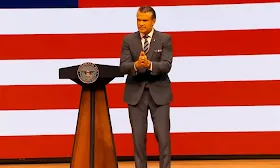
Pete Hegseth announced plans to cut general and admiral positions in the U.S. military by 20%. This decision has drawn attention for targeting diversity and various groups within the military, according to coverage in the latest US news and US and global politics.
What happened
Pete Hegseth has announced plans to reduce general and admiral positions by 20% within the military. This decision is part of a broader initiative aimed at restructuring leadership in the armed forces.
The Pentagon is working towards this goal, with implications expected to impact the top brass by January 1, making significant shifts in military management and operations. Hegseth’s address emphasized a commitment to streamlining the military hierarchy.
Key facts
- Pete Hegseth plans to cut 20% of general and admiral positions in the U.S. military.
- The Pentagon is set to implement these cuts by January 1.
- Hegseth’s initiatives include targeting perceived weaknesses within the military.
- The recent speech addressed topics such as diversity, transgender issues, and media criticism.
Where coverage differs
- The New York Times emphasizes Hegseth’s targeting of diversity and transgender people, while theguardian.com emphasizes Hegseth’s descriptions of military personnel using derogatory terms.
- Federal News Network foregrounds the operational details of the Pentagon’s plan to cut military positions rather than Hegseth’s inflammatory comments.
- The Washington Post prioritizes the implications of Hegseth’s speech for military personnel and operations over the controversies surrounding his rhetoric.
One story, four angles
The New York Times – In Speech, Hegseth Targets Diversity, Transgender People, Reporters and Iran
Publication: The New York Times | Primary framing pattern: political | Tone: critical | Intensity: 8/10 | Sentiment: negative | Legal precision: medium
Expand
Espresso Shot: This article critiques Pete Hegseth’s recent speech, emphasizing his controversial remarks about diversity and transgender issues. It highlights the implications of these remarks within a broader political context, particularly regarding military leadership and social values.
Publication emphasis: The emphasis is on the divisive nature of Hegseth’s speech in challenging prevailing social norms.
Framing analysis: The article foregrounds Hegseth’s targeting of marginalized groups, while providing less space for potential counterarguments or defenses of his position.
Bias: Selection: Focus on controversial statements
Language: Use of charged language like “targets” and “controversial”
Omission: Lack of support or audience response details
Assessment: The piece strongly critiques Hegseth’s rhetoric as harmful and provocative.
theguardian.com – Hegseth confirms plan to cut 20% of US top military brass and rails at ‘beardos, weirdos and wimps’
Publication: The Guardian | Primary framing pattern: political | Tone: critical | Intensity: 7/10 | Sentiment: negative | Legal precision: low
Expand
Espresso Shot: This article centers on Pete Hegseth’s call to reduce military leadership roles, portraying his remarks as derogatory towards certain groups within the military. The focus is on the implications of his planned cuts as well as his inflammatory language.
Publication emphasis: The emphasis is on the language used by Hegseth and its divisive nature within military contexts.
Framing analysis: The article foregrounds the negative implications of Hegseth’s rhetoric, highlighting his derogatory descriptors while presenting limited viewpoints from supporters.
Bias: Selection: Highlighting Hegseth’s controversial comments
Language: Use of loaded terms like “beardos, weirdos and wimps”
Omission: Lack of supportive perspectives or elaboration on potential benefits
Assessment: The piece critiques Hegseth’s approach as harmful and lacking in respect for military diversity.
Federal News Network – Pentagon to cut 20% of general and admiral positions by Jan. 1
Publication: Federal News Network | Primary framing pattern: policy | Tone: factual | Intensity: 5/10 | Sentiment: neutral | Legal precision: high
Expand
Espresso Shot: This article reports on the Pentagon’s decision to reduce leadership roles within the military, providing details on the implications of this policy adjustment and its operational significance. The writing is straightforward and focuses on factual reporting.
Publication emphasis: The emphasis is primarily on the logistical and structural changes within military leadership without delving into personal commentary.
Framing analysis: The article foregrounds the administrative aspects of the military cuts while relegating the political ramifications of the decision to a secondary concern.
Bias: Selection: Factual account of the Pentagon’s announcement
Language: Objective language devoid of emotionally charged terms
Omission: Insufficient discussion on public reactions or criticisms
Assessment: The article maintains a professional tone, prioritizing clarity and factual content over editorializing.
The Washington Post – Hegseth details new initiatives in partisan address to troops
Publication: The Washington Post | Primary framing pattern: political | Tone: analytical | Intensity: 6/10 | Sentiment: mixed | Legal precision: medium
Expand
Espresso Shot: This article analyzes Pete Hegseth’s recent address to military personnel where he outlines new initiatives. The discourse reflects partisan rhetoric while exploring the implications of his proposals on military culture and operations.
Publication emphasis: The piece emphasizes the potential impact of Hegseth’s initiatives on military culture and personnel dynamics.
Framing analysis: This article foregrounds the intersection of political initiatives and military culture, promoting a nuanced understanding of potential outcomes and reactions.
Bias: Selection: Focus on initiatives discussed
Language: Use of terms that evoke analysis rather than judgment
Omission: Limited critique on Hegseth’s political motivations
Assessment: The article provides a thoughtful examination of Hegseth’s address, balancing analysis with reportage.
Food for thought
The New York Times emphasizes the legal ramifications of Hegseth’s initiatives, framing his positions as a direct challenge to institutional norms and standards expected of military leadership. Conversely, The Guardian adopts a more escalatory tone, portraying Hegseth’s rhetoric as a sweeping critique of diversity and inclusion, invoking strong imagery such as “beardos, weirdos, and wimps” to signify a more combative stance. While the former concentrates on the implications of policy changes within a legal framework, the latter amplifies the confrontation surrounding those changes, reflecting deeper societal tensions. The facts do not change. What changes is where scrutiny lands.











Great article! This really puts things into perspective. I appreciate the thorough research and balanced viewpoint.
Interesting read, though I think there are some points that could have been explored further. Would love to see a follow-up on this topic.
Thanks for sharing this! I had no idea about some of these details. Definitely bookmarking this for future reference.
Well written and informative. The examples provided really help illustrate the main points effectively.
This is exactly what I was looking for! Clear, concise, and very helpful. Keep up the excellent work!