


EU leaders seek stronger ties with Middle East partners amid Iran war
EU leaders discussed boosting security and economic ties with Middle Eastern partners during talks in Nicosia amid ongoing conflicts, including a proposal for a multinational naval force.
Rising energy prices in Europe, exacerbated by the closure of the Strait of Hormuz, have cost over €25 billion in extra fossil fuel imports since the conflict began.
Syria’s interim President Ahmed al-Sharaa stated, “Bilateral relations with the EU are essential… particularly to ensure global security and the stability of supply chains.”
Key developments
EU leaders have committed to enhancing security and economic partnerships with Middle Eastern nations amid ongoing conflict, following discussions in Cyprus addressing the Iran war’s repercussions and regional stability.
During the talks, Syrian interim President Ahmed al-Sharaa highlighted the necessity of strong bilateral relations with the EU to ensure global security and supply chain stability amidst rising tensions.
European officials mentioned early considerations for a multinational force to escort commercial ships and clear mines in the Strait of Hormuz, signalling a potential shift in operational focus for regional stability.
EU leaders vow to boost security and economic ties with Middle East to minimise effect of Iran war

EU leaders vowed to boost security and economic ties with Middle East partners and push for a diplomatic end to the Iran war, after talks in Cyprus focusing on the fallout from the conflict.
Leaders from Lebanon, Egypt, Syria and Jordan as well as the secretary general of the Gulf Cooperation Council, were in Nicosia to meet their European Union counterparts on the sidelines of an EU summit.
“The current situation clearly underscores how closely Europe’s security is linked with that of the Middle East, and how vital our cooperation on security and defence has become,” European Council president António Costa told a press conference after the talks.
Although no formal decisions were taken, the summit provided an opportunity to exchange views about the war, the situation in Lebanon and across the Gulf, as well as the economic consequences for Europe amid the US blockade of Iranian ports and Tehran effectively shuttering the Strait of Hormuz.
“The recent ceasefires between the US and Iran, Israel and Lebanon are welcome developments. Now all parties must engage in good faith to achieve a peace. The European Union is not part of the conflict, but we will be part of this solution,” European Council President Antonio Costa said at a press conference on Friday.
Fighting has currently been suspended in both Iran and Lebanon. Earlier this week, US President Donald Trump said that a ceasefire with Iran that was due to expire on 22 April had been extended indefinitely, while on Thursday he said that a suspension of hostilities between Israel and Hezbollah in Lebanon had been extended for three weeks.
Meanwhile, the White House said on Friday evening that special envoy Steve Witkoff and Jared Kushner would head to Pakistan for a second round of talks on Saturday.
European officials have floated the idea of a multinational force to escort commercial ships and clear mines in the Strait of Hormuz, but the plan remains at an early stage and it is unclear whether it will be implemented.
Even if EU leaders are actively avoiding direct involvement in the war, they’re aiming to provide support to Middle Eastern countries affected by it, which the EU considers strategic partners in energy, migration and digitalisation.
Syria’s interim President Ahmed al-Sharaa was among the key regional figures at the talks and he reiterated the importance of bilateral relations with the EU and described them as “essential and inevitable, particularly to ensure global security and the stability of supply chains.”
At the same time, he asked the international community to “uphold its responsibilities in addressing all forms of Israeli aggression affecting our land and territories.”
Increasing energy prices in Europe
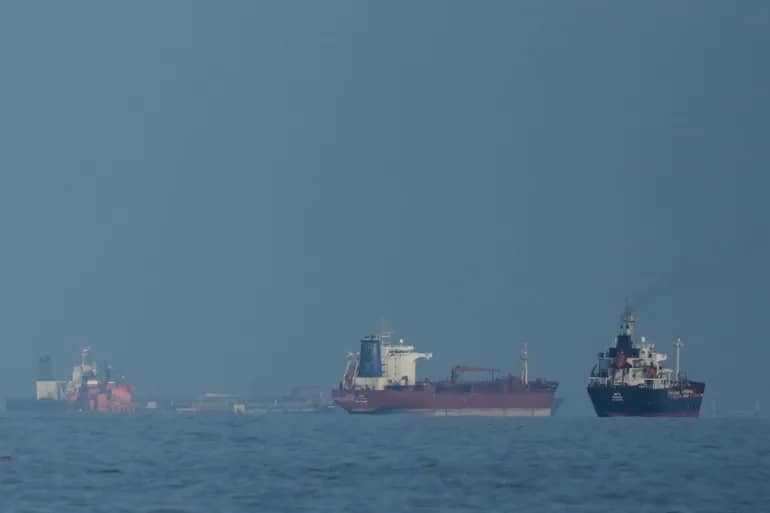
Another topic of discussion was rising energy prices around the world due to the closure of the Strait of Hormuz.
The standoff is choking off nearly all exports through the vital waterway, through which around 20% of the world’s traded oil passes in peacetime.
The disruption has sent energy prices soaring across Europe, prompting fears of shortages and economic decline.
EU leaders discussed a set of new measures unveiled by the European Commission earlier this week, such as social schemes, tax reductions and subsidies for green technologies.
“Since the beginning of this conflict, our bill for imported fossil fuels has increased by over €25 billion without a single molecule of energy in addition. We need to reduce our over-dependency on important fossil fuels because these make us vulnerable to crises,” European Commission President Ursula von der Leyen said on Friday.
Von der Leyen also said work was under way to boost economic, trade and political ties with Jordan, Egypt, Syria and Gulf nations and proposed those partnerships broaden to defence matters.
“We could consider expanding the scope of missions like Operation Aspides evolving from mere protection to a sophisticated joint maritime coordination,” she said without providing further details.
Aspides is the EU’s naval mission in the Red Sea, launched in 2024 to prevent attacks on trade vessels by Iran-backed Houthi rebel forces.
“The threat of mass proliferation of drones and missiles is sadly a shared reality. We should set up a structural cooperation of scaling up defence production,” von der Leyen added.






Great article! This really puts things into perspective. I appreciate the thorough research and balanced viewpoint.
Interesting read, though I think there are some points that could have been explored further. Would love to see a follow-up on this topic.
Thanks for sharing this! I had no idea about some of these details. Definitely bookmarking this for future reference.
Well written and informative. The examples provided really help illustrate the main points effectively.
This is exactly what I was looking for! Clear, concise, and very helpful. Keep up the excellent work!