

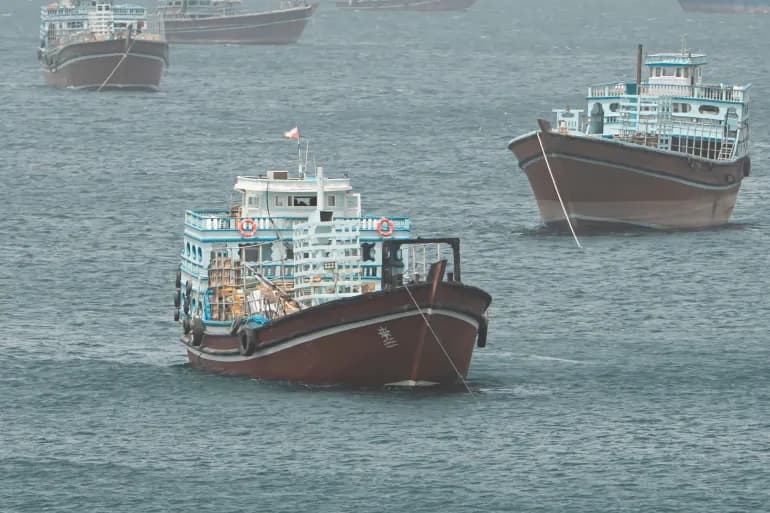
Get you up to speed: Iran claims it coordinated passage of 26 vessels out of Hormuz in 24 hours
Iran’s Islamic Revolutionary Guard Corps (IRGC) announced it coordinated the passage of 26 vessels through the Strait of Hormuz in the past 24 hours. The statement, reported by Iran’s state-affiliated ISNA news agency, asserts that traffic is being conducted “with permission and in coordination” with the IRGC Navy.
The Islamic Revolutionary Guard Corps (IRGC) has claimed control over the Strait of Hormuz, coordinating the passage of 26 vessels amid ongoing tensions. The blockade initiated by the United States on Iranian ports has severely impacted global energy markets, with significant concerns about a potential food price crisis highlighted by the Food and Agriculture Organization of the United Nations.
Iran’s Islamic Revolutionary Guard Corps (IRGC) stated it facilitated the passage of 26 vessels through the Strait of Hormuz, asserting control over the waterway amid ongoing tensions. Meanwhile, the Food and Agriculture Organization of the United Nations warned of a potential severe global food price crisis within six to 12 months due to disruptions, labelling the situation as “the beginning of a systemic agrifood shock.”
What remains unclear — It is uncertain how many vessels are awaiting transit through the Strait of Hormuz amid the ongoing blockade.
Iran coordinates passage of 26 vessels through Strait of Hormuz in 24 hours
News|US-Israel war on Iran Iran claims it coordinated passage of 26 vessels out of Hormuz in 24 hours
The IRGC claims to maintain control over the Strait of Hormuz despite the US blockade on Iran’s ports.
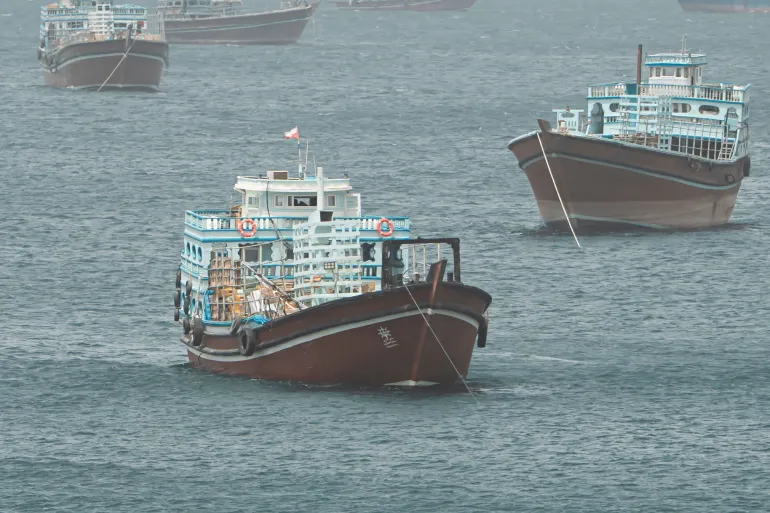 Vessels navigate the Strait of Hormuz near Musandam, Oman, May 20, 2026 [Reuters]
Iran’s Islamic Revolutionary Guard Corps (IRGC) has said it coordinated the transit of 26 vessels through the Strait of Hormuz in the past 24 hours, as talks between Washington and Tehran over the resumption of traffic through the narrow waterway remain stalled.
“Traffic through the Strait of Hormuz is being carried out with permission and in coordination with the IRGC Navy,” the statement carried by Iran’s state-affiliated ISNA news agency said on Wednesday.
About a fifth of global energy exports used to pass through the strait before the beginning of the United States-Israel war on Iran on February 28, which prompted Tehran to blockade the waterway.
US President Donald Trump’s administration responded by imposing a blockade on Iranian ports, choking Iranian oil exports – the country’s key source of revenue.
The standoff has put huge strain on global energy markets as well as raising concerns over a looming humanitarian catastrophe.
On Wednesday, the Food and Agriculture Organization of the United Nations (FAO) warned that the blockage could trigger a severe global food price crisis within six to 12 months, calling the disruption “the beginning of a systemic agrifood shock”.
The Rome-based agency said the disruption is no longer only a shipping or energy-market problem, warning that the shock is moving through global agrifood systems in stages.
“The shock is unfolding in stages: energy, fertilizer, seeds, lower yields, commodity price increases, then food inflation,” the FAO said.
Stalled talks
On Wednesday, Trump spoke about “progress” made in negotiations with Iran. But he also threatened to resume military action if Iran does not agree to a deal.
Iran’s Foreign Minister Abbas Araghchi warned “return to war will feature many more surprises”. The IRGC also said that if Iran is attacked again, it would widen the conflict by extending fighting “this time” beyond the region.
Will Todman, senior fellow at the Center for Strategic and International Studies, told WTX News that the warring sides seem convinced that extending their respective blockades will earn them more leverage against the other.
“I think it’s very difficult to see something that will fundamentally change the calculation, because both sides seem to believe that the longer this goes on, the greater their leverage will be because the more their opponents will be suffering economically,” Todman said on Wednesday.








Great article! This really puts things into perspective. I appreciate the thorough research and balanced viewpoint.
Interesting read, though I think there are some points that could have been explored further. Would love to see a follow-up on this topic.
Thanks for sharing this! I had no idea about some of these details. Definitely bookmarking this for future reference.
Well written and informative. The examples provided really help illustrate the main points effectively.
This is exactly what I was looking for! Clear, concise, and very helpful. Keep up the excellent work!