


Get you up to speed: House Republicans pull vote on Iran war resolution that appeared to have enough support to pass
House Republicans postponed a vote on a measure requiring President Trump to withdraw from the war with Iran due to insufficient support, highlighting ongoing challenges in securing congressional backing for the conflict. The decision came as Democrats, led by Rep. Gregory Meeks, expressed confidence in their ability to pass the resolution amid a continuing ceasefire between the U.S. and Iran.
The House narrowly rejected a war powers resolution last week, resulting in a tie of 212-212, with three Republicans voting in favour. Under the War Powers Resolution of 1973, the legal framework mandates that Congress must authorise military action within 60 days, a timeline that has now expired.
House Republicans postponed the vote on a war powers resolution amid concerns about inadequate support, with House Republican Leader Steve Scalise stating the delay allowed absent lawmakers a chance to participate. Meanwhile, a growing number of Republican lawmakers are questioning the legality of President Trump’s military actions, with Rep. Brian Fitzpatrick asserting, “We’re past 60 days so it’s got to be brought to us to vote on,” indicating potential congressional pushback on military engagement without their approval.
What remains unclear — It is uncertain how Congress will ultimately resolve its authority over military conflicts given the differing interpretations of the War Powers Resolution.
House Republicans cancel vote on Iran war resolution that had sufficient support
House Republicans on Thursday pulled a vote on a measure that would compel President Trump to withdraw from the war with Iran, delaying action on the issue as the Trump administration struggles to maintain congressional backing for the war.
The House had scheduled a vote on a war powers resolution, brought by Democrats, that would rein in Mr. Trump’s ability to wage war with Iran without congressional approval. But as it became clear that Republicans would not have the numbers to defeat the bill due to absences, GOP leaders declined to hold a vote on it.
“We had the votes without question and they knew it, and as a result they’re playing a political game,” said Democratic Rep. Gregory Meeks of New York, who sponsored the resolution and serves as the top Democrat on the House Foreign Affairs Committee.
It was the latest sign of uncertain support in Congress for a war that Mr. Trump launched almost three months ago, though the U.S. and Iran remain in a shaky ceasefire that began in early April.
Francis Chung/POLITICO via AP Images 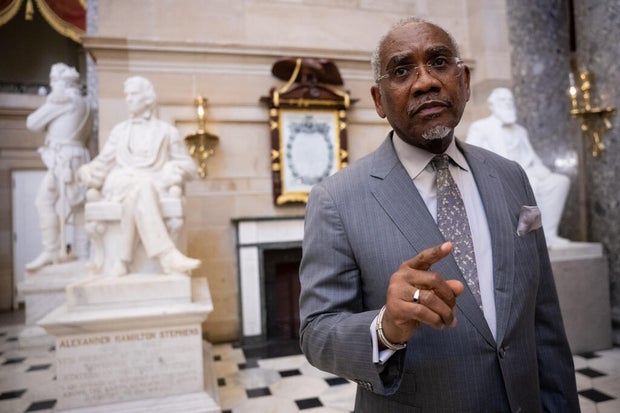
Last week, the House narrowly rejected a war powers resolution in a 212-212 tie, after three Republicans voted in favor. Earlier this week, the Senate voted to advance an war powers resolution, with four GOP senators supporting the measure and three others absent. The successful vote marked only a first step in the Senate, but it still marked a milestone for Democrats after seven failed attempts to advance Iran-related measures.
House Republican Leader Steve Scalise told reporters Thursday’s vote was delayed to give lawmakers who were absent a chance to vote. House Speaker Mike Johnson did not answer questions from reporters as he exited the House chamber.
In a joint statement, House Minority Leader Hakeem Jeffries and other Democratic caucus leaders said Republicans were “cowardly” to pull the vote.
“Even as we prepare to recognize our nation’s fallen heroes on Memorial Day, House Republicans refuse to show up and be accountable to the brave service members that have been recklessly put in harm’s way,” they added.
On Capitol Hill, patience with the war has worn thin. Polling shows most Americans disapprove of the U.S. taking military action against Iran and do not believe the conflict is going well, and while direct fighting is largely on hold due to the ceasefire, the stalemate in the Strait of Hormuz has disrupted global shipping and elevated gas prices in the U.S.
The lone Democrat who voted against the war powers resolution last week, Rep. Jared Golden of Maine, has said he will vote in favor of the legislation next time.
Most congressional Republicans have been broadly supportive of Mr. Trump’s efforts to destroy Iran’s nuclear capabilities.
“I’m an American. I don’t believe in getting hit and walking away and pretending as though it didn’t happen,” said Rep. Brian Mast, the Republican chair of the House Foreign Affairs Committee.
Still, a growing number of Republicans are now saying the president’s legal timeline to wage a war without congressional approval has expired. Under a 1973 law, presidents have 60 days to engage in a military conflict before Congress must either declare war or authorize the use of military force.
“We’re past 60 days so it’s got to be brought to us to vote on. We’re following the law,” said Rep. Brian Fitzpatrick, a Pennsylvania Republican, adding that he plans to vote for the war powers resolution.
The White House argues that the requirements of the War Powers Resolution no longer apply because of the ceasefire with Iran. At the same time, Mr. Trump said he was just an hour away from ordering another strike on Iran earlier this week, but held off because Gulf allies said they were engaged in negotiations to end the war.
The president said on social media earlier in the week that military leaders should “be prepared to go forward with a full, large scale assault of Iran, on a moment’s notice, in the event that an acceptable Deal is not reached.”
For Congress, the growing momentum to pass a war powers resolution could eventually lead to a legal showdown over who has the final authority over military conflicts.
The legislation before the House is a concurrent resolution that lawmakers said would take effect without Mr. Trump’s signature if it passed both chambers of Congress. But Mr. Trump has also argued that the 1973 law — passed by Congress during the Vietnam War era in an attempt to take back its power over foreign conflicts — is unconstitutional.
Sen. Thom Tillis, a North Carolina Republican who has so far voted against the war powers resolutions, expressed frustration with the Trump administration’s stance, especially from Defense Secretary Pete Hegseth.
“The current status quo, Pete Hegseth demonstrates how incompetent he is,” Tillis told reporters, adding that he would be willing to vote for an authorization for use of military force.














Great article! This really puts things into perspective. I appreciate the thorough research and balanced viewpoint.
Interesting read, though I think there are some points that could have been explored further. Would love to see a follow-up on this topic.
Thanks for sharing this! I had no idea about some of these details. Definitely bookmarking this for future reference.
Well written and informative. The examples provided really help illustrate the main points effectively.
This is exactly what I was looking for! Clear, concise, and very helpful. Keep up the excellent work!