

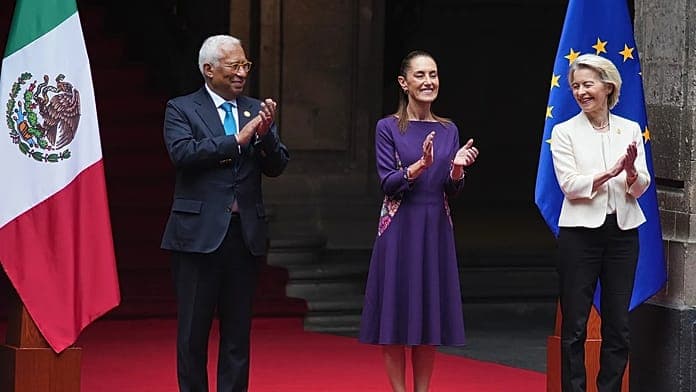
EU and Mexico sign revamped trade deal to strengthen economic ties
The European Commission President Ursula von der Leyen and European Council President António Costa signed a revamped trade deal with Mexico, updating a 20-year-old agreement.
The updated EU–Mexico trade deal enhances market access for agri-food products, pharmaceuticals, and machinery, reinforcing economic ties amid geopolitical volatility.
“Today’s modernised Agreements set out our shared vision of the future and will deliver many benefits for both sides,” stated Ursula von der Leyen.
EU clinches new trade deal with Mexico to bolster its foothold in Latin America
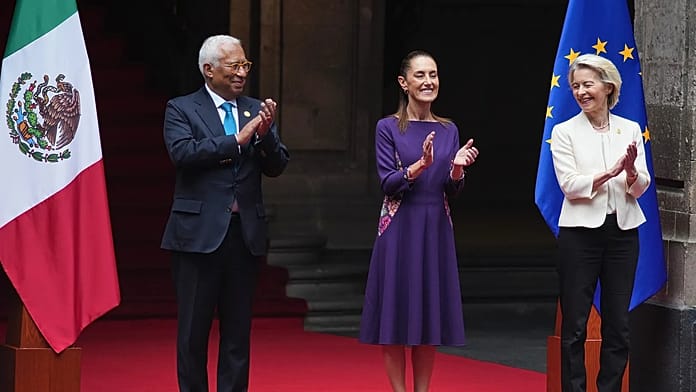
European Commission President Ursula von der Leyen and European Council President António Costa signed on Friday a revamped trade deal with Mexico as part of the EU’s efforts to expand its influence in Latin America, shortly after the Mercosur pact entered into force.
The deal was signed at an EU–Mexico summit in Mexico, with von der Leyen and Costa joined by the country’s President Claudia Sheinbaum, amid rising geopolitical tensions and shifting global alliances following the return of US president to the White House.
The economic partnership between the two medium-sized powers reflects efforts on both sides to reduce their dependence on the US — the EU’s and Mexico’s largest trading partner—and on China, for which Mexico has become a hub for electric vehicle production.
“The EU and Mexico are committed to a close strategic partnership,” von der Leyen said, adding: “Today’s modernised Agreements set out our shared vision of the future and will deliver many benefits for both sides.”
The EU–Mexico trade deal strengthens the EU’s diversification strategy by updating a 20-year-old agreement that had already eliminated tariff barriers on bilateral trade.
Under the new deal, the EU will access new markets for products, such as agri-food (pork, dairy, cereals, fruit and pasta), pharmaceuticals and machinery.
EU tightens trade ties in Latin America
Mexico is the EU’s second-largest trading partner in Latin America and the EU is Mexico’s second-largest export market. Trade between both sides reached €86.8 billion in goods in 2025, alongside €29.7 billion in services in 2024.
The figures remain far smaller than Mexico’s trade with its neighbour, the US, which exceeded $900 billion in goods and services in 2024. But the deal comes as Mexico faces mounting pressure from a more protectionist White House.
For its part, the EU has been grappling with repeated tariff threats from Trump despite a trade deal clinched in 2025.
“At a time of growing global uncertainty, the EU and Mexico are choosing openness, partnership and ambition,” EU trade Commissioner Maroš Šefčovič, who was also in Mexico City, said. He pointed out that more than 43,000 European companies export to Mexico, while over 11,000 EU companies operate in the country.
On agriculture, the pact will open up new markets for Mexican products such as coffee, fruit, chocolate and agave syrup.
A total of 568 European and 26 Mexican geographical indications will also be protected, alongside the opening of public procurement markets, according to the Commission.
With this new deal, the EU also wants to signal its strengthened presence in Latin America, where China has expanded its influence.
“97% of the GDP of Latin America and the Caribbean will be covered by sophisticated preferential agreements with the European Union,” a senior EU official said, adding: “There is no other region in the world that has such a dense and connected network of agreements.”
The EU has already built new trade ties with Argentina, Brazil, Paraguay and Uruguay through the Mercosur trade agreement, which provisionally entered into force on 1 May and liberalises trade flows between the EU and those countries.
However, its signing has faced strong opposition from EU farmers, who fear unfair competition from Latin American imports, and ratification was suspended after MEPs challenged the agreement before the EU court of Justice.
Brussels argues the Mexico agreement should avoid the backlash faced by Mercosur because sensitive agricultural imports remain capped through tariff quotas.










Great article! This really puts things into perspective. I appreciate the thorough research and balanced viewpoint.
Interesting read, though I think there are some points that could have been explored further. Would love to see a follow-up on this topic.
Thanks for sharing this! I had no idea about some of these details. Definitely bookmarking this for future reference.
Well written and informative. The examples provided really help illustrate the main points effectively.
This is exactly what I was looking for! Clear, concise, and very helpful. Keep up the excellent work!