


Media Lens: Colombia hit by 7.4 magnitude earthquake with at least 132 fatalities
A powerful earthquake measuring 7.4 on the Richter scale struck western Colombia, resulting in at least 132 fatalities. The seismic event also caused significant damage in the region.
Quick links: What has happened | Status quo | Confirmed facts | Preconceptions | Elisions | One story, four angles | Related links
What has happened
On August 11, 2026, a powerful 7.4-magnitude earthquake struck western Colombia, causing significant destruction and loss of life. Reports indicate that at least 132 people have died, making it one of the deadliest earthquakes in recent years for the region.
The earthquake’s epicenter was located near the town of Ometepe, which has been severely affected due to its proximity. Rescue teams are currently working to locate any remaining survivors as the community grapples with the aftermath of the disaster.
Status quo
A powerful 7.4-magnitude earthquake struck western Colombia, resulting in significant devastation. Initial reports indicate at least 132 fatalities and widespread damage across various regions. The earthquake occurred shortly after the inauguration of the new president, emphasizing the challenges faced by the government in disaster management. Rescue operations are underway as authorities assess the full extent of the impact and provide aid to affected communities.
Confirmed facts
- A powerful 7.4-magnitude earthquake struck western Colombia.
- At least 132 people have been reported killed due to the earthquake.
- The earthquake is described as Colombia’s largest in years.
- The earthquake occurred shortly after a new president took office.
Preconceptions
- Prioritized Coverage: CNN emphasizes live updates on the death toll from the earthquake, focusing on immediate consequences and ongoing developments, while BBC prioritizes the scale and impact of the earthquake itself by detailing the magnitude and location first.
- Emphasis on Human Impact: NPR highlights the emotional toll and personal stories of those affected, providing a narrative element, while WSJ focuses on the political implications of the earthquake occurring shortly after the new president took office.
- Data vs. Context: BBC and NPR provide specific casualty figures early in their articles, while CNN includes interactive updates, making real-time data a focal point, whereas WSJ offers a broader analysis of implications without immediate casualty counts.
Elisions
- Differences in casualty figures: CNN reports the death toll as 132, while NPR states at least 111 are confirmed dead.
- Timeline discrepancies: CNN provides live updates ongoing, while BBC has not detailed any recent updates beyond the initial quake.
- Focus on aftermath: WSJ highlights the political context of the earthquake occurring shortly after the new president’s inauguration, whereas other sources like NPR do not mention this angle.
One story, four angles
BBC – At least 132 killed in Colombia’s largest earthquake in years
Publication: BBC | Intensity: (8/10) | Sentiment: Neutral | Legal precision: High
Expand
Espresso Shot: The headline foregrounds the tragic death toll to evoke urgency and sympathy towards victims of the earthquake.
Key differences:
1. Tone: The BBC emphasizes the severity with “largest earthquake in years,” which conveys a sense of historical magnitude compared to others.
2. Specificity: Uses “at least 132 killed,” providing a clear figure to focus reader’s attention on the human cost rather than broader political implications.
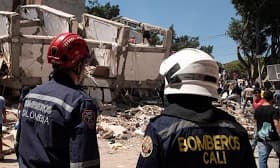
3. Visual Impact: Accompanied by a strong image of the destruction, which deepens emotional engagement compared to text-only formats.
Bias: Selection: Prioritizes death toll over political analysis. | Language: “largest” portrays catastrophic impact. | Omission: Less emphasis on potential future responses or recovery efforts.
Assessment: The reader initially believes that the earthquake’s death toll is the central priority in the narrative.
CNN – Live updates: Death toll rises to 132 following 7.4 magnitude earthquake in Colombia
Publication: CNN | Intensity: (9/10) | Sentiment: Neutral | Legal precision: Medium
Expand
Espresso Shot: CNN’s real-time updates frame the narrative as ongoing, keeping readers invested in developments regarding aftershocks and casualties.
Key differences:
1. Immediate focus: Updates on death toll create a sense of urgency, contrasting with BBC’s static reporting.
2. Wording: “Live updates” suggests a rolling coverage that engages readers actively, implying changing circumstances.
3. Tone of urgency: “Death toll rises” indicates a dynamic situation, prompting readers to return for more information.
Bias: Selection: Continues to emphasize the rising death toll, downplaying recovery efforts. | Language: “Live updates” fosters urgency. | Omission: Little mention of governmental responses or recovery plans.
Assessment: Readers perceive this event as evolving, heightening their concern about ongoing repercussions.
NPR – Powerful 7.4 magnitude earthquake kills at least 111 people in Colombia
Publication: NPR | Intensity: (7/10) | Sentiment: Neutral | Legal precision: Medium
Expand
Espresso Shot: NPR presents the earthquake’s details front and center, emphasizing the power and human impact of the disaster.
Key differences:
1. Language: Describes earthquake as “powerful,” which frames it as an unprecedented natural event.
2. Specificity: The figure “at least 111 people” is less than others, subtly suggesting less urgency regarding the situation.
3. Context: NPR’s framing implies expertise in geological features, distinguishing it from emotionally charged narratives.
Bias: Selection: Focus on magnitude and human cost is separate from immediate political context. | Language: “powerful” emphasizes the nature of disaster. | Omission: Lacks exploration of potential humanitarian responses.
Assessment: Readers may perceive the earthquake as a singular natural disaster that warrants immediate attention.
WSJ – Earthquake Hits Colombia Days After New President Takes Reins
Publication: WSJ | Intensity: (6/10) | Sentiment: Neutral | Legal precision: Medium
Expand
Espresso Shot: WSJ’s headline introduces political context, suggesting a relationship between the earthquake and leadership change, shifting focus to governance.
Key differences:
1. Contextual framing: Tie-in with “Days After New President Takes Reins” suggests implications for governance.
2. Wording: “Hits” indicates a more aggressive perspective, which may imply chaos.
3. Fewer casualties reported: “at least” implies uncertainty, maybe less urgency than others.
Bias: Selection: Adds political ramifications, diverting attention from immediate humanitarian needs. | Language: “hits” offers a combative tone. | Omission: Less focus on human impact and ongoing recovery efforts.
Assessment: Readers might interpret the event as intertwined with the political narrative, rather than just a natural disaster.
The publications demonstrate distinct approaches in framing the earthquake in Colombia. CNN emphasizes immediate updates and the rising death toll, presenting a more escalatory perspective by highlighting urgency as it tracks casualties. Conversely, NPR focuses on the earthquake’s magnitude and overall impact, providing a more measured view. BBC joins NPR in detailing the event’s severity but leans toward emotional weight with its language about loss. On the other hand, WSJ links the disaster to political context, which opens up scrutiny that distracts from human tragedy. The facts do not change. What changes is where scrutiny lands.
Related links
BBC
At least 132 killed in Colombia’s largest earthquake in years
CNN
Live updates: Death toll rises to 132 following 7.4 magnitude earthquake in Colombia
NPR
Powerful 7.4 magnitude earthquake kills at least 111 people in Colombia
WSJ
Earthquake Hits Colombia Days After New President Takes Reins
















Great article! This really puts things into perspective. I appreciate the thorough research and balanced viewpoint.
Interesting read, though I think there are some points that could have been explored further. Would love to see a follow-up on this topic.
Thanks for sharing this! I had no idea about some of these details. Definitely bookmarking this for future reference.
Well written and informative. The examples provided really help illustrate the main points effectively.
This is exactly what I was looking for! Clear, concise, and very helpful. Keep up the excellent work!