

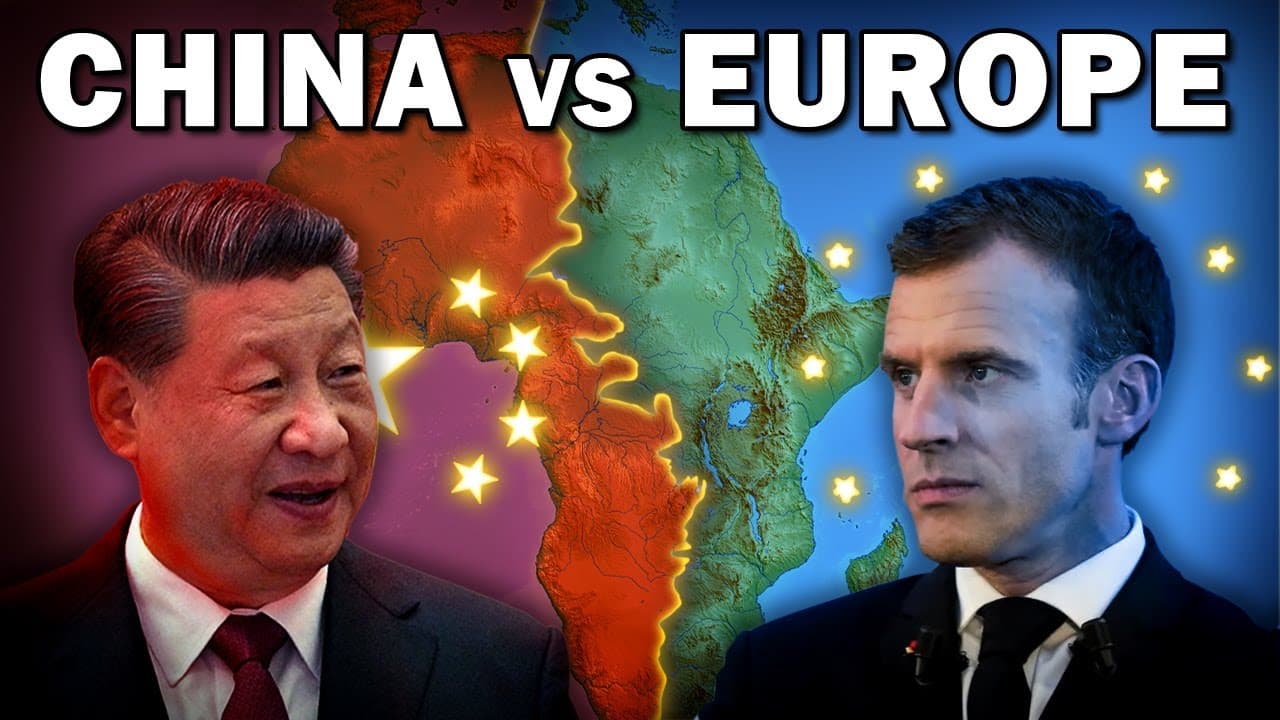
Cliff Notes – How the European Union looks to counter China in Africa
- The EU aims to enhance cooperation with Africa through the Global Gateway Initiative, promoting infrastructure projects and local value creation to better compete with China’s influence.
- The EU and AU summit in Luanda emphasised the urgency of addressing Africa’s economic challenges and fostering multilateralism amid global crises affecting trade and security.
- Africa’s young population represents significant potential for future collaboration, with a pressing need for job creation and education to avoid economic dependency on external powers like China.
How the European Union looks to counter China in Africa
Maria Magdalena and her four children live in a wooden hut in a small settlement on the sandy soil of the Ilha do Cabo peninsula in Angola. From here, she can see cargo ships waiting in endless lines to enter the harbour in the country’s capital, Luanda.
Angola is rich in raw materials, but the vast majority of the population lives in poverty.
Magdalena also has a view of the city’s skyline but is not following the key summit in the capital’s government district on the other side of the bay. It is hard enough for her to organise her daily life.
“I urgently need work. Without work, I cannot feed my children,” she said.
Africa and Europe in crisis mode
In Luanda, the African Union (AU) and the European Union (EU) held their seventh summit under the theme “promoting peace and prosperity through effective multilateralism.” Together, they represent 82 countries with a population of almost 2 billion people.
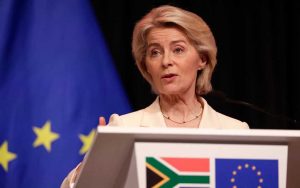
Pressure has never been this high. “As we all know, uncertainty prevails on the international stage. The established norms of international geopolitics are being challenged,” Mahmoud Youssouf, the chair of the AU Commission, said ahead of the conference in a statement.
Russia is fighting a war in Europe, US President Donald Trump levies radical tariffs and breaks the rules of the World Trade Organization. China pushes aggressively into global markets. Conflicts in Africa are intensifying: a brutal war rages in Sudan, and jihadist extremism spreads across the Sahel region.
In addition, parts of Africa suffer greatly from climate change. “Droughts destroy livelihoods. It’s a dangerous mix. And people take dangerous routes across the Atlantic and the Mediterranean,” German Chancellor Friedrich Merz stated at the summit.
Before rushing to the conference hall, Merz attended an informal last-minute meeting of EU leaders. Even in Africa’s Luanda, there are discussions on how to proceed in Russia’s war against Ukraine.
For Merz and the other heads of state and government, this amounts to politics in crisis mode, while Africa and Europe seek to close ranks. In the summit’s final declaration, they insist on a world order “based on international law and effective multilateralism.”
Africa’s potential and Europe’s dependence
The European Union is Africa’s largest trading partner and investor. According to European Commission President Ursula von der Leyen, one-third of all African exports go to Europe.
If you dig a little deeper a huge portion of that trade involves exploitation trade that has existed for decades, oil, diamonds, gold and African currencies which rely on French banking.
“We don’t want to leave the continent to others,” warned Merz, referring to China primarily. Through its Belt and Road Initiative, China has been investing in Africa’s bridges, ports and roads. Even the brand-new airport in Luanda was built and financed by China as a prestige project.
“China helped rebuild Angola after the civil war in 2002 with loans and infrastructure projects,” Vandre Spellmeier of the delegation of the German Industry and Commerce in Angola (AHK Angola), told DW.
In his view, it is “not too late for the European Union.” Angola is now trying to free itself from the crushing debt it owes China, he explained.
Local value creation instead of exports
“This future African and European cooperation should emphasise the exchange of knowledge and skills that contribute to transforming African local economies,” Hermine Sam, Program Coordinator South at the German Marshall Fund, said in an interview to EU news on X.
Many African countries have critical raw materials that Europe needs for its energy transition and industry: rare earths, copper, cobalt and lithium. However, there is much competition, and Africa wants to avoid unilateral dependencies.
“The world does not consist of just one or two countries. We work with everyone who is open to us,” said Angola’s President Joao Lourenco, the current chair of the AU. “We are open to the world.”
Otherwise, the old spiral remains, she said. “Raw materials leave cheaply and return expensively processed.”
Olaf Wientzek, head of the German Konrad Adenauer Foundation’s multinational development dialogue in Brussels, also sees this as leverage. “Strengthening local processing capacities, that’s where Europe can score points against China,” he told EU News.
European procedures are often stricter and slower, he admits. “But Europe wants to give the economy more participation than China.”
Global Gateway: Europe’s answer to China
The Global Gateway Initiative is often viewed as the EU’s response to China. The investment program supports infrastructure projects with EU financing and private investors.
One of Global Gateway’s prestigious projects is being built in Angola: the Lobito Corridor, a railway line connecting the raw-material regions of Angola, the Democratic Republic of Congo and Zambia with the Atlantic coast. Businesses are to be established along the route, ranging from agriculture to logistics.
The EU is proud of this showcase project. “While we connect Africa to global markets, we are also supporting trade within your continent. I think this is the best way for African companies to scale up and prepare for global competition,” von der Leyen said.
Germany’s Merz supported her statement. “The European single market is a great success story and the largest peace project Europe has ever seen. And it is precisely against this backdrop that Germany has supported the Pan-African Free Trade Area from the outset,” he said.
Yet there is considerable criticism. “In its conception, Global Gateway was not developed in consultation with African stakeholders and overlooked African priorities,” Hermine Sam told EU News. She said the EU is frequently criticised for “making big speeches but delivering little, especially compared to China.”
What remains after Luanda’s summit?
Africa is a particularly young continent: 40% of its population is under 15 years old. They need education, jobs, and housing. This is in stark contrast to Europe, where only 16% are under 15.
“The young African generation, which is creative, dynamic, and rapidly growing, is one of the greatest assets for our shared future,” European Council President Antonio Costa stated.
But what remains after the two days of EU-AU summit in Luanda, which the government declared a public holiday in view of the many international guests? Magdalena, the mother of four, says she avoids politics. She is frying food on a small charcoal fire. She, too, has hopes for the future.
“I’m young. I really need work urgently.”







Great article! This really puts things into perspective. I appreciate the thorough research and balanced viewpoint.
Interesting read, though I think there are some points that could have been explored further. Would love to see a follow-up on this topic.
Thanks for sharing this! I had no idea about some of these details. Definitely bookmarking this for future reference.
Well written and informative. The examples provided really help illustrate the main points effectively.
This is exactly what I was looking for! Clear, concise, and very helpful. Keep up the excellent work!