


Get you up to speed: European Commission Urges Orbán and Zelenskyy to De-escalate Rhetoric
European Commission urges Viktor Orbán and Volodymyr Zelenskyy to reduce their inflammatory rhetoric over the Druzhba pipeline amid rising confrontations.
Ursula von der Leyen is expected to propose alternative options to unblock the €90 billion loan for Ukraine amid ongoing tensions between Orbán and Zelenskyy.
Ukrainian President Zelenskyy stated that repairs to the Druzhba pipeline might take up to one and a half months to complete.
Briefing summary
The European Commission urged Hungarian Prime Minister Viktor Orbán and Ukrainian President Volodymyr Zelenskyy to reduce their rhetoric over the contentious Druzhba pipeline dispute.
In response, Orbán vetoed a €90 billion loan to Ukraine and detained a bank cargo destined for Ukraine, prompting accusations of “state terrorism” from Kyiv.
Full report
The European Commission has called on Hungarian Prime Minister Viktor Orbán and Ukrainian President Volodymyr Zelenskyy to immediately reduce their “inflammatory rhetoric” regarding the Druzhba pipeline, amid escalating tensions between the two leaders.
Orbán recently vetoed a €90 billion loan to Ukraine, previously endorsed by 27 EU leaders, in response to a halt in oil supplies. Olof Gill, the Commission’s deputy chief spokesperson, warned that such rhetoric is unhelpful in achieving shared objectives, which include exerting pressure on Russia and ensuring energy security for member states.
In a rapid exchange, Orbán threatened to “break the Ukrainian oil blockade by force,” while Zelenskyy appeared to suggest sharing Orbán’s address with Ukrainian soldiers, a statement Budapest interpreted as a death threat. Hungary also detained a bank cargo heading to Ukraine, which Kyiv condemned as “state terrorism.”
As diplomatic efforts continue, Gill noted that the Commission is exploring “possible financial support” to expedite repairs on the Druzhba pipeline. The situation has become increasingly complex, with looming elections in Hungary and calls for cooperation from both sides underlined by European Commission President Ursula von der Leyen’s outreach to Zelenskyy.
Full reading
The European Commission has publicly urged both Hungarian Prime Minister Viktor Orbán and Ukrainian President Volodymyr Zelenskyy to immediately “dial down” their “inflammatory rhetoric” over the Druzhba pipeline, which has pitted the two leaders in a head-to-head confrontation without precedent.

ADVERTISEMENT
ADVERTISEMENT
In response to the halt in oil supplies, Orbán has vetoed a €90 billion loan to Ukraine that the 27 EU leaders had signed off on in December.
“At the moment, there is a lot of escalatory rhetoric and inflammatory rhetoric,” Olof Gill, the Commission’s deputy chief spokesperson, said on Friday afternoon.
“We believe that such rhetoric from all sides is neither helpful nor conducive to achieving the common goals that we have.”
In the last 24 hours, Orbán threatened to “break the Ukrainian oil blockade by force”. In turn, Zelenskyy seemingly suggested he give Orbán’s personal address to Ukrainian soldiers to convince him to lift the veto, which Budapest interpreted as a death threat.
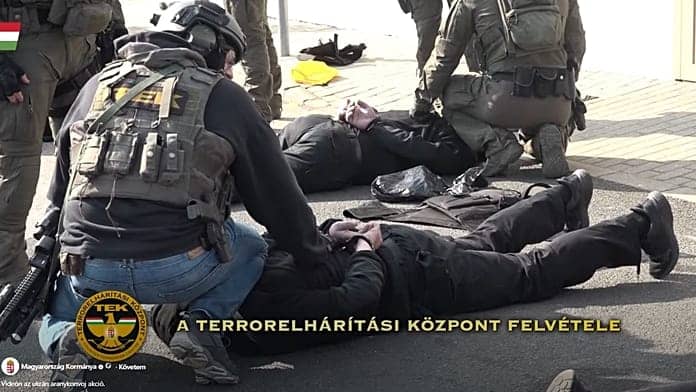
On Friday, Hungary detained a bank cargo heading to Ukraine carrying $40 million, €35 million and 9 kg of gold in reserves, which Kyiv condemned as “state terrorism”.
The row has caught Brussels in the middle.
“We’re in active discussions with all sides in this question,” Gill said.
“Our objective here is to get everyone to calm down a bit, dial down the rhetoric and deliver on the objectives: to take every possible step we can to put pressure on Russia to end its war of aggression, to deliver on the loan for Ukraine (and) to ensure that our member states have energy security,” he added.
“The Commission will continue to work calmly and coherently with all sides to ensure that those objectives are met.”
Asked about Zelenskyy’s suggestion that Ukrainian soldiers be given Orbán’s address, the spokesperson made his displeasure clear — one of the few times Brussels has openly rebuked the Ukrainian leader.
“We are very clear, as the European Commission, that that type of language is not acceptable. There must not be threats against EU member states,” Gill said.
As part of the diplomatic efforts to solve the dispute, the Commission is examining “possible financial support” to speed up the repairs of Druzhba, Gill added, without providing further details.
Von der Leyen’s outreach
The status of the pipeline has become a hot topic of contention since a Russian drone attack was reported on 27 January.
Hungary and Slovakia, which are entitled to receive Russian crude thanks to an indefinite sanctions derogation, insist they have intelligence to demonstrate that Druzhba is operational and is being shut because of “political reasons”.
Ukraine says the opposite: that its evidence proves that Druzhba remains damaged and cannot resume deliveries. Zelenskyy has said the repair might take up to one and a half months to be finished, while warning that conditions on the ground are dangerous.
“There are certain things and principles that are priceless and simply cannot be compromised,” he said on Thursday in a briefing with journalists.
“They (Russians) are killing us, and we have to give oil to Orbán because, poor thing, he cannot win the elections without this oil. So that’s my position.”
European Commission President Ursula von der Leyen has personally asked Zelenskyy to accelerate the repair works. Earlier this week, von der Leyen called Zelenskyy and asked him to be constructive and cooperative to find a solution that is viable for all parties, according to people familiar with the conversation.
European Council President António Costa is also involved in the outreach to ease tensions between Orbán and Zelenskyy and ensure the delicate agreement reached by the 27 leaders in December comes to fruition.
However, the dramatic escalation of threats between Kyiv and Budapest has derailed attempts at conciliation. Privately, officials in Brussels admit that Zelenskyy made a mistake with his veiled remarks about Orbán’s address, which the Hungarian premier is now exploiting in his re-election campaign.
The fact that Orbán is trailing in opinion polls ahead of the 12 April contest is further complicating diplomacy. Officials worry that the longer the row drags on and the closer it gets to 12 April, the harder it will be to untangle.
Initially, Brussels had operated under the assumption that Kyiv would need a fresh injection of money in early April, but the timeline could now slip.
Von der Leyen said last week she had “options” to unblock the €90 billion loan, but her executive has yet to spell out what those options might look like.
Meanwhile, the Commission chief has received an invitation to meet with Slovak Prime Minister Robert Fico. A date is being considered.
This article has been updated for clarity.










Great article! This really puts things into perspective. I appreciate the thorough research and balanced viewpoint.
Interesting read, though I think there are some points that could have been explored further. Would love to see a follow-up on this topic.
Thanks for sharing this! I had no idea about some of these details. Definitely bookmarking this for future reference.
Well written and informative. The examples provided really help illustrate the main points effectively.
This is exactly what I was looking for! Clear, concise, and very helpful. Keep up the excellent work!