

Get you up to speed: US to designate two Brazilian gangs as ‘terrorist’ organisations
The United States announced that it will designate the Primeiro Comando da Capital (PCC) and Comando Vermelho as “terrorist” organisations, effective June 5. This decision involves Secretary of State Marco Rubio and follows discussions between President Donald Trump and Brazilian Senator Flavio Bolsonaro this week.
The designation of the Primeiro Comando da Capital (PCC) and Comando Vermelho as “Foreign Terrorist Organizations” will take effect on June 5, while both groups have already been categorised as “Specially Designated Global Terrorists”. Brazilian President Luiz Inacio Lula da Silva has voiced concerns regarding the implications of these labels on financial institutions and ongoing political tensions amid the upcoming presidential elections.
The Trump administration’s planned designation of Primeiro Comando da Capital and Comando Vermelho as “terrorist” organisations has prompted Brazilian President Luiz Inacio Lula da Silva to express concerns over potential foreign interference and the implications for financial institutions interacting with these groups. In response, Lula’s adviser, Celso Amorim, emphasised the need for cooperation in combating organised crime but warned against any pretext for US intervention, asserting that such actions would be “unacceptable.”
What remains unclear — It is uncertain how the “terrorist” designation will impact financial institutions and individuals in Brazil in relation to the PCC and Comando Vermelho.
US plans to classify two Brazilian gangs as terrorist organisations
News|Donald TrumpUS to designate two Brazilian gangs as ‘terrorist’ organisations
The Trump administration has used crime and drug trafficking to push for greater US military influence across Latin America.
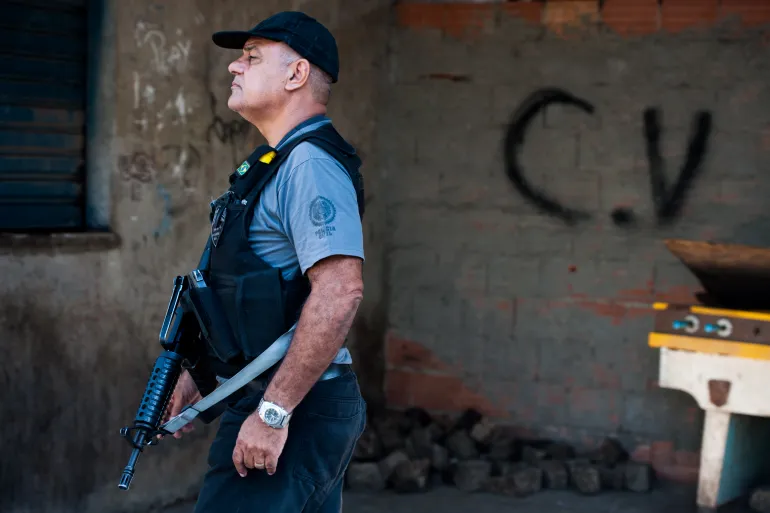
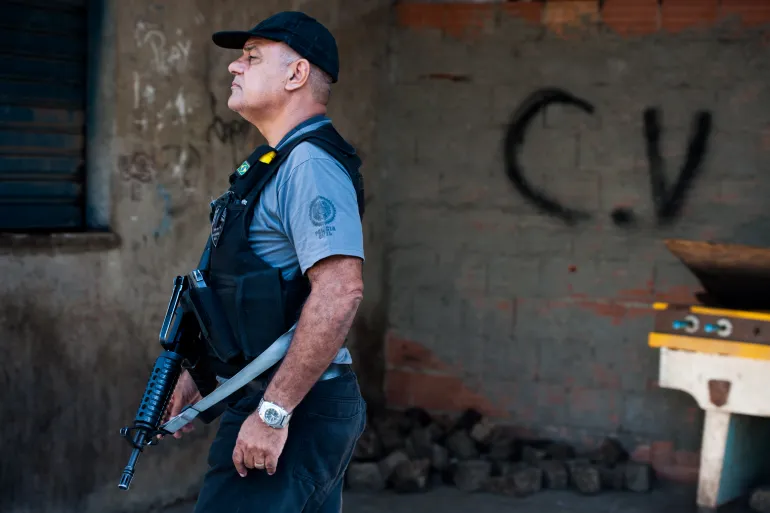 Brazilian military police walk past graffiti for the criminal group Comando Vermelho on March 30, 2014, in Rio de Janeiro, Brazil [Buda Mendes/Getty Images]
The United States has announced its intention to designate two Brazilian gangs as “terrorist” organisations, continuing a push under President Donald Trump to blur the distinction between criminal and “terrorist” activity.
Secretary of State Marco Rubio said on Thursday that the designations would target the Primeiro Comando da Capital (PCC) and the Comando Vermelho, the two largest criminal networks in Brazil.
list of 3 itemslist 1 of 3Trump and Lula hold phone call to discuss US tariffs on Brazil, sanctionslist 2 of 3How many countries has Trump bombed in 2025?list 3 of 3At least eight killed as Brazilian police carry out lethal favela raidend of list
The “Foreign Terrorist Organization” label will be effective starting June 5.
In the meantime, Rubio explained that they had already been assigned to the category of “Specially Designated Global Terrorists”, a similar category that draws its authority from the International Emergency Economic Powers Act (IEEPA).
Both designations block the groups’ access to US assets, though the “foreign terrorist” label is considered to be more restrictive.
Rubio said the measures were necessary to ensure the safety of US citizens.
“The Trump Administration will continue to use all available tools to protect our nation and our national security interests by keeping illicit drugs off our streets and disrupting the revenue streams funding violent narco-terrorists,” Rubio said in a statement.
Since returning to the White House for a second term, Trump has sought “terrorist” designations for multiple Latin American criminal networks.
The efforts have been criticised as a pretext to expand US military influence across the Western Hemisphere, as part of Trump’s “Donroe Doctrine”, his spin on the 19th-century expansionist policy known as the Monroe Doctrine.
But the decision to designate two Brazilian criminal groups is likely to send shockwaves in the South American country’s politics, where a heated presidential election is under way.
Media reports have indicated that left-wing Brazilian President Luiz Inacio Lula da Silva has repeatedly tried to dissuade the Trump administration from applying the “terrorist” designation.
The fear is that such a designation could be used to penalise any group that comes in contact with the so-called “terrorist” group, including financial institutions and victims facing extortion.
Lula has also expressed concern about the growing threat of foreign interference in Latin America, particularly after a January 3 military operation in which the US abducted Venezuelan President Nicolas Maduro.
Lula is running for a fourth non-consecutive term as president in October’s presidential race. While Lula is a critic of Trump, his main opponent, right-wing Senator Flavio Bolsonaro, has close ties with the US administration.
Thursday’s announcement comes after Trump met with Bolsonaro this week at the White House. The senator told reporters afterwards that he had actively petitioned Trump to designate the PCC and Comando Vermelho as “terrorist” groups.
Trump has previously intervened in Brazilian politics on the Bolsonaro family’s behalf.
Last year, he raised tariffs against Brazil to nearly 50 percent in an act of solidarity with Bolsonaro’s father, former President Jair Bolsonaro.
Like Trump, Jair Bolsonaro was indicted for attempting to subvert democracy after his 2022 election defeat. Despite Trump’s calls for the case against the elder Bolsonaro to end, the former president was ultimately sentenced to 27 years in prison.
The ex-president’s younger son, Eduardo Bolsonaro, is currently facing trial for obstruction for seeking Trump’s intervention on his father’s behalf.
The question of public safety is likely to loom large in the race between Flavio Bolsonaro and Lula, whom polls show to be neck and neck.
Recent clashes between law enforcement and criminal groups like the Comando Vermelho are also expected to weigh heavily on the presidential election.
Last October, for instance, a police raid in Rio de Janeiro left more than 120 people dead. Another operation in March killed eight people.
Critics of the police raids have argued that decades of militarised confrontation have fuelled violence and rights abuses.
“Armed confrontation with young drug traffickers from the outskirts is ineffective and fails to deal with the complexity of money laundering and its links to financial crime,” Luis Flavio Sapori, a sociologist and public safety expert at Pontifical Catholic University of Minas Gerais, told The Associated Press news agency.
To address public security concerns, Lula launched a $2bn initiative in March to attack the financial underpinnings of criminal networks like the PCC and the Comando Vermelho.
The money is also slated for use in disrupting arms trafficking, improving the prison system and investing in homicide investigations.
In the aftermath of Thursday’s “terrorist” designations, Celso Amorim, Lula’s adviser on foreign affairs, warned that the US should not use the label to infringe upon Brazilian sovereignty.
“Organized crime is an evil that must be fought. International cooperation is welcome, especially in matters of money laundering and arms trade,” Amorim said.
But, he added, any “pretext for intervention” would be “unacceptable”.








Great article! This really puts things into perspective. I appreciate the thorough research and balanced viewpoint.
Interesting read, though I think there are some points that could have been explored further. Would love to see a follow-up on this topic.
Thanks for sharing this! I had no idea about some of these details. Definitely bookmarking this for future reference.
Well written and informative. The examples provided really help illustrate the main points effectively.
This is exactly what I was looking for! Clear, concise, and very helpful. Keep up the excellent work!