


Get you up to speed: UK prime minister Keir Starmer holds firm against US pressure over Iran conflict
Keir Starmer has refused to commit British warships to the Strait of Hormuz amid ongoing tensions in the Middle East. The British public’s support for Starmer’s stance has increased, with a recent poll showing his net approval rating jumped by 26 points when he pushed back on comments made by Donald Trump.
Keir Starmer has declared that Britain will “never contemplate going to war without a legal basis,” emphasizing the painful lessons of Iraq, according to a recent statement. Amid rising tensions with the United States and threats from President Trump regarding Iran, public support for Starmer’s stance has reportedly increased, with a net approval rating jump of 26 points following his refusal to commit British warships to the Gulf region.
Keir Starmer has taken a firm stance against engaging in the conflict in the Middle East, stating that Britain will “never contemplate going to war without a legal basis.” As tensions rise, the situation may pressure him economically, particularly with increased petrol prices and energy bills, impacting Labour’s position ahead of the local elections in May.
Keir Starmer finally got his backbone – bottling it now would be disastrous | News World
 London, Britain March 16, 2026. BROOK MITCHELL/Pool via REUTERS/File Photo” decoding=”sync”/>
Starmer has rediscovered his backbone (Picture: REUTERS)
There’s a version of Keir Starmer that British people have grown wearily familiar with over the past 18 months.
It goes something like this: he makes a policy announcement, there’s pushback, and he U-turns.
In September last year, he announced a mandatory digital ID scheme for people to prove their right to work in Britain. Within a week, public support had cratered by 10 points. Faced with that, and backlash from his own MPs, he rowed back and made it non-compulsory.
Or when Labour looked like they were doubling down on the unfair farmer’s inheritance tax, only to change the threshold just before Christmas. Or the winter fuel payments. Two-child benefit cap. Welfare reform.
This list goes on.
But something has shifted in recent weeks. As the Middle East has lurched from crisis to crisis, Starmer has done something miraculous.
He’s rediscovered his backbone.
I’ve found it thrilling to watch Starmer stand his ground. He’s refused to commit British warships to the Strait of Hormuz. He has absorbed public mockery from the most powerful man in the world – being called ‘no Winston Churchill’ and ‘not helpful’ by Trump. But, to his great credit, Starmer has shrugged it off and held firm: Britain will not be dragged into a war that is, at its core, an exercise in distraction and coercion.
And as it turns out, I’m not the only one. The British public rather likes it too.
A recent poll over the weekend found that Starmer’s net approval rating jumped by 26 points, from minus 40 to minus 14, when voters saw him pushing back on Trump.
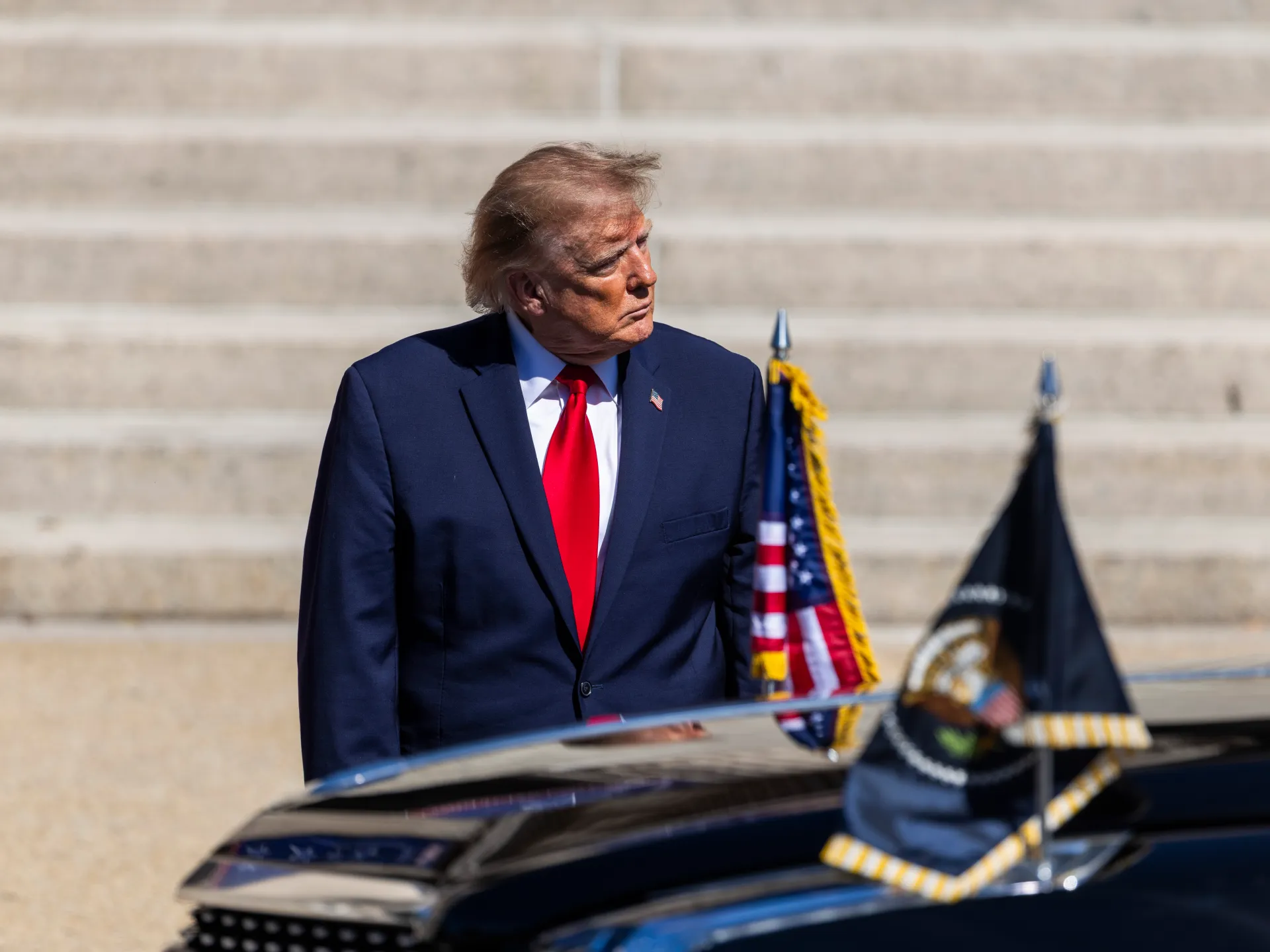
 Washington D.C. on Sunday following a weekend trip to Florida. (Photo by Nathan Howard/Getty Images)” decoding=”async” loading=”lazy”/>
Trump is at it again – and I can’t help but feel apprehensive about whether Starmer can hold his nerve (Picture: Nathan Howard/Getty Images)
He is still in negative territory – this is not an overnight transformation – and the public hasn’t forgotten that, despite his initial refusal to allow the US to use British bases for offensive strikes on Iran, he later sanctioned their use for defensive ones.
But that 26-point gap is the difference between a leader who is politically finished and one who has found, however inadvertently, a story that works.
Now comes the hard part: Trump is at it again – and I can’t help but feel apprehensive about whether Starmer can hold his nerve. If he bottles it now, it will surely seal his fate.
Yesterday, the US President posted on Truth Social that the United States will ‘completely obliterate’ Iran’s power plants, oil wells and Kharg Island – its most strategically vital oil terminal – unless a peace deal is reached ‘shortly’ and the Strait of Hormuz is immediately reopened.
This follows the recent 48-hour ultimatum, which was quietly extended by five days hours before the deadline was reached, with Trump claiming ‘productive conversations’ with Tehran that they outright denied.
Just another day in Trump’s administration.
We have been here before; the pattern is established. Trump issues a threat intended to compel and coerce, his opposition holds firm, Trump blinks first, reframes his retreat as diplomacy, and issues a new threat. Greenland, Venezuela and Cuba all follow this pattern.

Just another day in Trump’s administration (Picture: EPA/WILL OLIVER / POOL)
But regardless of the President’s volatile geopolitical strategies, his war has a direct effect on Starmer’s room for manoeuvre.
The longer the Strait stays shut, the more pressure builds on Starmer, with prolonged economic strain resulting in rising petrol prices, energy bills, stalled economic recovery.
Should the economic pressure eventually force Starmer’s hand in the Middle East, his 26-point approval boost evaporates. The strong character he has spent a month carefully building – principled restraint, legal basis, lessons of Iraq – collapses immediately.
For our beleaguered PM, I’m not sure there’s any coming back from that.
Trump’s war is not Britain’s war. Starmer’s position not to engage in the conflict is not just politically popular; it is legally and morally correct.
The President has now openly threatened to destroy civilian power infrastructure – cutting electricity to millions, knocking out water desalination plants across the Gulf, potentially affecting nuclear facilities.
While attacks on energy infrastructure have long been part of warfare, there are limits. If civilians are harmed in the process, it is a clear breach of international humanitarian law.
And of course Trump, being the man he is, will continue to goad Starmer to take the bait. Today, the President addressed the UK on Truth Social, saying, ‘You’ll have to start learning how to fight for yourself, the USA won’t be there to help you anymore, just like you weren’t there for us.’
In the face of all of this, Starmer must stand firm. Britain will, as he said, ‘never contemplate going to war without a legal basis’. The painful lessons of Iraq demand nothing less. We need him to hold that commitment to the British people, so that the man who has kept Britain out of Trump’s war doesn’t become the one who quietly joins it.
My fear is that Starmer’s instinct may be to reach for a compromise. To find a way to keep everyone happy, to avoid confrontation. For him, the temptation to pursue this route would be perilous, to say the least.

The British public has given Starmer something rare and valuable: a clear mandate to stay out (Picture: BETTY LAURA ZAPATA / BLOOMBERG POOL / EPA)
The local elections in May are already looking grim for Labour. The economy is stalling, and Trump’s war in Iran has wrecked whatever growth projections Rachel Reeves was clinging to.
Anyone who argues that a grand gesture of solidarity with America – ships in the Gulf, boots near the Strait – might project strength ahead of a difficult night at the ballot box, should be ignored.
The British public has given Starmer something rare and valuable: a clear mandate to stay out.
They do not want this war. They are watching a president threaten to obliterate civilian infrastructure in real time, and they are not cheering it on.
Starmer has stumbled into the right position almost despite himself.
The question is whether he has the nerve to stay there.
Share your views in the comments below.
Comment now
Comments
Add WTX as a Preferred Source on Google













Great article! This really puts things into perspective. I appreciate the thorough research and balanced viewpoint.
Interesting read, though I think there are some points that could have been explored further. Would love to see a follow-up on this topic.
Thanks for sharing this! I had no idea about some of these details. Definitely bookmarking this for future reference.
Well written and informative. The examples provided really help illustrate the main points effectively.
This is exactly what I was looking for! Clear, concise, and very helpful. Keep up the excellent work!