


The B-52: America’s Continued Use of a 1960s Bomber in Modern Warfare
B-52 Upgrades
Rolls-Royce is equipping B-52H bombers with new engines, extending their service life into the 2050s.
Recent discussions confirm that B-52 bombers from the US will utilize UK bases in a response to rising tensions in the Middle East.
76 B-52H bombers remain operational in the USAF, set to be equipped with new Rolls-Royce engines ensuring their service until at least the 2050s.
Briefing summary
The Boeing B-52 Stratofortress, integral to the United States Air Force, remains in service with 76 aircraft, accounting for half of the USAF’s bomber fleet.
Rolls-Royce is enhancing the B-52H with new engines to extend its operational lifespan into the 2050s, supporting ongoing missions in the region.
Full reading: The B-52: Why the US still uses a plane from the 1960s to bomb its enemies | World News
When Washington DC wants to attack its enemies, the aircraft US presidents often turn to is the Boeing 52 Stratofortress bomber.
The B-52H model, which still flies today, was first brought into service with the United States Air Force (USAF) in 1961.
More than 63 years later, 76 of the bombers continue in service with the US, forming the backbone of the country’s bomber force and accounting for half of the USAF’s bombers.
Follow Iran war updates live
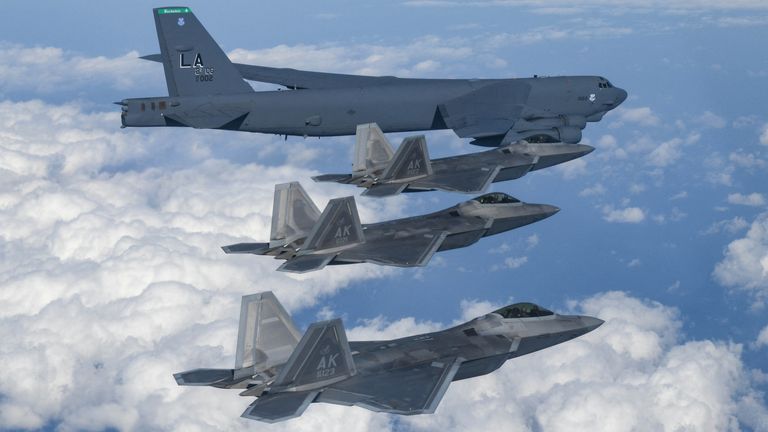
A US B-52 alongside F-22s. Pic: Reuters
Rolls-Royce is now equipping the Cold War era nuclear-capable bombers with new engines that will help keep them in the sky until at least the 2050s.
US News understands that B-52 bombers are currently on their way to the UK.
The move comes after Sir Keir Starmer‘s change of position, granting US assets permission to use British bases for defensive strikes against Iran.
So, what has kept these airframes in the air and in such demand?

B-52 bombers were deployed along the Venezuelan coast ahead of the capture of Nicolas Maduro. Pic: Reuters
Serious fire power
The B-52 is commonly referred to with the more vulgar acronym of BUFF – Big Ugly Fat Fella – by air force crews who regularly use the craft.
The sheer size of the Stratofortress makes it capable of carrying about 70,000 lbs (31,751 kg) of arms, including bombs, smart weapons, mines and missiles.
The H model can also carry up to 20 air-launched cruise missiles.
The B-52 can carry nuclear weapons as well as conventional ones – including gravity bombs and nuclear-armed cruise missiles.
While the bombers can pack a punch, they also boast an impressive range of 8,800 miles, which can be extended through mid-air refuelling, and a speed of 650mph.
They’re also cheaper to operate than some of their newer competitors.
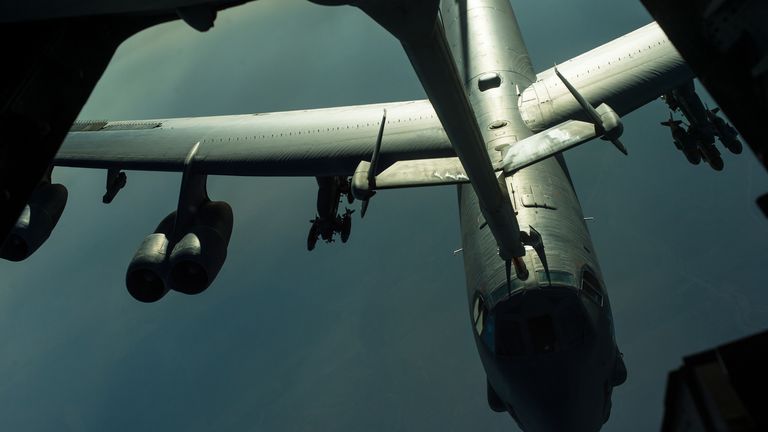
A US B-52 bomber during mid-air refuelling. Pic: Reuters
The aircraft is typically crewed by five mission personnel: the aircraft commander, pilot, radar navigator, navigator and electronic warfare officer.
A staple of US conflicts
The B-52 was originally designed to carry thermonuclear explosives and act as part of the US nuclear deterrent.
Since then, it’s frequently been used for attacks that deploy an arsenal of deadly conventional weapons.
US commanders used the plane heavily during the Vietnam War with extensive carpet-bombing runs.
In 1972, US B-52 bombers dropped over 20,000 tonnes of explosives on North Vietnam during 11 days as part of Operation Linebacker II.
The bombers played a significant role in Operation Desert Storm in 1991 during the Gulf War and again in the 2003 invasion of Iraq.
Read more:
Donald Trump‘s Iran war going global
Strategy behind US-Israeli Iran strikes
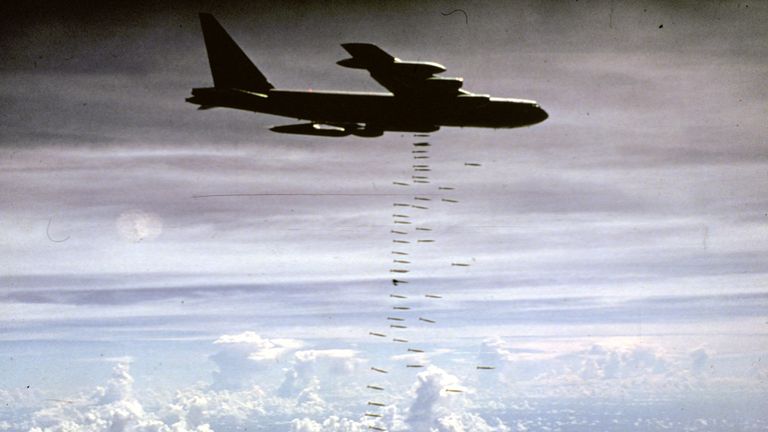
US B-52 bomber striking targets in Vietnam between 1965 to 1973. Pic: Reuters
In 2014, President Barack Obama deployed the aircraft, which entered service before he was born, against ISIS forces in Syria and Iraq.
B-52s flew about 1,800 combat sorties against the terrorist group.
The bomber is being used again now alongside the B-1 bomber, this time on the orders of President Donald Trump, against Iran.
Such is the B-52H’s reputation that even the repositioning and deployment of the jet to an area can be used as a diplomatic tool and not-so veiled threat.
The long-range jets were sent to patrol off the coast of Venezuela as Trump ramped up threats to former president Nicolas Maduro in the days before his capture by US forces.















Great article! This really puts things into perspective. I appreciate the thorough research and balanced viewpoint.
Interesting read, though I think there are some points that could have been explored further. Would love to see a follow-up on this topic.
Thanks for sharing this! I had no idea about some of these details. Definitely bookmarking this for future reference.
Well written and informative. The examples provided really help illustrate the main points effectively.
This is exactly what I was looking for! Clear, concise, and very helpful. Keep up the excellent work!