


Media Lens: Spain votes in snap general election with record voter turnout
Spain holds a snap general election as voters decide on their next government. The election comes amid significant political shifts in the country.
Quick links: What has happened | Status quo | Confirmed facts | Preconceptions | Elisions | One story, four angles | Related links
What has happened
Spain held a snap general election on November 29, 2026, with voters participating in what has been described as a pivotal moment for the country’s political landscape. Key issues such as the economy and immigration heavily influenced the campaign, with the conservative People’s Party positioning itself against the ruling Socialist Workers’ Party led by Pedro Sánchez.
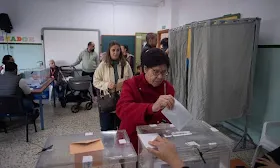
Voter turnout reached record levels, reflecting heightened public interest and engagement in this election cycle. Early exit polls suggest that the conservative People’s Party may need to rely on far-right coalitions to secure a governing majority.
Status quo
Spain held a snap general election on November 29, 2026, allowing voters to select members of the national parliament. This election was called in response to shifting political dynamics and the call for early elections by various parties. As the polls closed, results began to emerge regarding voter turnout and party performance, indicating a significant election with potential implications for the country’s governance.
Confirmed facts
- Spain held a snap general election.
- The conservatives won the election but would need support from far-right parties to govern.
- Record turnout was reported in the election.
- The polls closed in mainland Spain during the election.
Preconceptions
- Politico.eu prioritises the high turnout aspect of the Spanish election, showcasing it in the headline, while CNN emphasizes the election’s result focusing on the Conservatives’ need for far-right support to govern post-election.
- Al Jazeera highlights the election dynamics by discussing exit polls and potential coalition formations, while BBC covers the immediate outcome and its implications for the Socialist party in a brief manner.
- Politico.eu provides detailed context around the historical significance and voter turnout statistics, whereas CNN’s coverage leans towards the post-election implications without in-depth analyses.
- Al Jazeera focuses on pre-election sentiments and potential coalition scenarios, while BBC emphasizes the procedural aspects as polls close, reducing speculative elements in its reporting.
Elisions
- BBC highlights the closing of polls and the potential change in leadership, while Politico focuses on record turnout, omitting detailed election dynamics.
- CNN emphasizes the need for coalition government and the implications of far-right support, whereas Al Jazeera provides less analysis on coalition possibilities, focusing instead on polling predictions.
- While all sources report on the election results, none specifically cover public reactions or protests related to the election outcome, indicating a gap in understanding voter sentiments.
One story, four angles
POLITICO.eu – Record turnout in pivotal Spanish election
Publication: POLITICO.eu | Intensity: (7/10) | Sentiment: Positive | Legal precision: Moderate
Expand
Espresso Shot: Readers are guided to focus on the high voter turnout, suggesting a democratic engagement climate ahead of the elections.
Key differences:
– Emphasizes the result of the election and turnout, e.g., “Record turnout,” compared to other outlets that mention results later in their headlines.
– Suggests importance through the term “pivotal,” indicating a major shift.
– Notably takes a proactive tone regarding electoral engagement, unlike CNN’s more cautious framing.
Bias: Selection: Highlights the turnout as a positive indicator | Language: The term “pivotal” implies significant implications | Omission: Does not address potential controversies about the election itself.
Assessment: The reader believes highly of the public engagement in this election.
CNN – Conservatives win Spain’s election but would need far right to govern, polls show
Publication: CNN | Intensity: (6/10) | Sentiment: Mixed | Legal precision: Moderate
Expand
Espresso Shot: The focus is on the outcome for conservatives and the dependence on far-right elements for governance, suggesting instability.
Key differences:
– The lead mentions the need for coalition, emphasizing potential governance difficulties, contrasting with POLITICO’s focus on turnout.
– Uses “but would need” language framing as a cautionary stance versus a more affirmative view from POLITICO.
– Highlights electoral division, whereas other outlets emphasize popular support.
Bias: Selection: Emphasizes the coalition requirements and potential challenges | Language: “Need far right” conveys instability | Omission: Lacks context on voter motivations or turnout statistics.
Assessment: The reader believes the election outcome highlights challenges facing the new administration.
Al Jazeera – Exit poll puts Spain’s conservatives and far right within reach of majority
Publication: Al Jazeera | Intensity: (5/10) | Sentiment: Negative | Legal precision: Moderate
Expand
Espresso Shot: The focus lies on the proximity of conservatives and far-right achieving a majority, indicating potential polarization in governance.
Key differences:
– Implies a looming threat in “within reach of majority” versus the celebratory tone found in POLITICO.
– Indicates a precarious political landscape by emphasizing “exit poll” rather than confirmed results.
– Suggests a negative future outlook compared to other publications focused on voter turnout.
Bias: Selection: Draws focus on political factions’ coalition potential | Language: “within reach” creates tension suggesting instability | Omission: Does not incorporate the overall voter engagement or democratic participation.
Assessment: The reader believes that the election results could lead to a troubling political environment.
BBC – Spain election: Polls close in mainland Spain as conservatives seek to oust Socialist Pedro Sánchez
Publication: BBC | Intensity: (6/10) | Sentiment: Neutral | Legal precision: High
Expand
Espresso Shot: The headline puts emphasis on the competitive nature of the election, stressing the conservatives’ goal to displace the current leadership.
Key differences:
– Highlights “ouster” indicating a direct challenge to existing leadership, contrasting with the more analytical take from CNN.
– Focuses on the act of closing polls, implying an imminent outcome versus POLITICO’s focus on participation.
– Maintains a neutral tone, unlike the negative implications seen in Al Jazeera’s reporting.
Bias: Selection: Highlights the conflict between two dominating factions | Language: “seek to oust” carries strong active language | Omission: Does not address the voter sentiment beyond the competitive aspect.
Assessment: The reader believes that the election centers on a pivotal power shift in government.
Among the various publications covering Spain’s recent election, CNN adopted the most escalatory framing by emphasizing potential far-right governance, portraying a looming ideological shift. In contrast, POLITICO.eu highlighted record voter turnout, reflecting a more neutral and positive angle on the democratic process. Al Jazeera’s reporting also indicated the far-right’s positioning but emphasized the broader political landscape, while BBC focused on the election mechanics. Overall, CNN’s framing escalates concerns, while POLITICO.eu’s approach showcases a more traditional democratic narrative.
The facts do not change. What changes is where scrutiny lands.
Related links
POLITICO.eu
Record turnout in pivotal Spanish election
CNN
Conservatives win Spain’s election but would need far right to govern, polls show
Al Jazeera
Exit poll puts Spain’s conservatives and far right within reach of majority
BBC
Spain election: Polls close in mainland Spain as conservatives seek to oust Socialist Pedro Sánchez











Great article! This really puts things into perspective. I appreciate the thorough research and balanced viewpoint.
Interesting read, though I think there are some points that could have been explored further. Would love to see a follow-up on this topic.
Thanks for sharing this! I had no idea about some of these details. Definitely bookmarking this for future reference.
Well written and informative. The examples provided really help illustrate the main points effectively.
This is exactly what I was looking for! Clear, concise, and very helpful. Keep up the excellent work!