


Media Lens: Russia launches drone strike on Ukrainian train after officials’ visit
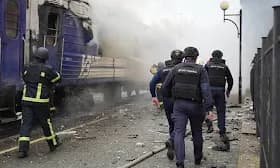
Russian forces launched a drone strike targeting a train in Ukraine, shortly after a visit from former British Prime Minister Boris Johnson and other European officials. The incident occurred in a region along the Ukraine-Poland border, intensifying concerns among NATO neighbours.
Quick links: What has happened | Status quo | Confirmed facts | Preconceptions | Elisions | One story, four angles | Related links
What has happened
A recent drone strike in Ukraine targeted a train station shortly after the departure of British Prime Minister Boris Johnson and other European officials. This attack occurred as tensions remain high in the region, particularly near the Ukraine-Poland border, prompting concerns among NATO allies.
The strike highlights the ongoing military operations in Ukraine and the challenges faced by the government there amidst the conflict. As international leaders continue to engage with the situation, the event underscores the precarious nature of security in the area.
Status quo
Context is not necessary.
Confirmed facts
- Russia conducted a drone strike near the Ukraine-Poland border.
- The attack has raised concerns among NATO neighbors.
- Several sources reported on a drone strike targeting a train in Ukraine.
- This incident occurred shortly after high-ranking officials, including Boris Johnson, left the station.
Preconceptions
- The Washington Post focuses primarily on detailed personal accounts, emphasizing firsthand experiences of events such as the drone targeting in Ukraine, while reducing broader geopolitical context.
- CNN emphasizes immediate implications of military actions, like the drone strike near the Ukraine-Poland border, highlighting potential NATO responses, yet provides less depth on individual narratives compared to The Washington Post.
- BBC covers the immediate aftermath of military actions, such as the strike on a train, prioritizing potential impacts on high-profile political figures, while offering less emphasis on direct human experiences.
- The Institute for the Study of War prioritizes analytical assessments of military strategies and operational efficiency, highlighting data-driven evaluations over personal stories or political implications, showcasing a more detached journalistic approach.
Elisions
- The Washington Post reported on a drone strike near the Ukraine-Poland border but did not provide details on the international ramifications, while CNN highlighted the strategic implications on NATO without specifying the civilian impact.
- BBC mentioned the timing of a drone strike on a Ukrainian train but omitted mention of the political context surrounding the visit of Western officials, unlike the coverage by other sources that included this detail.
- While the Institute for the Study of War provided a comprehensive military analysis, it lacked coverage on how these military actions are affecting local civilian populations, which other outlets like CNN addressed more thoroughly.
One story, four angles
The Washington Post – What I saw when drones targeted a train in Ukraine, with ex-CIA director aboard
Publication: The Washington Post | Intensity: (7/10) | Sentiment: Neutral | Legal precision: High
Expand
Espresso Shot: Focus is directed towards an on-the-ground perspective of drone strikes in Ukraine, particularly highlighting the involvement of a former CIA director.
Key differences:
1. Comparison to CNN: The Washington Post includes a more personal narrative about eyewitness accounts, highlighted by the phrase “what I saw,” contrasting with CNN’s more detached analytical approach.
2. Use of ex-CIA director: The mention of a high-profile individual provides weight to the observations, a strategy less utilized in CNN’s coverage.
3. Timeliness: The Washington Post emphasizes the immediacy with phrases like “with ex-CIA director aboard,” creating urgency compared to the distant references in others.
Bias: Selection: Focuses primarily on an insider’s viewpoint that may overlook broader perspectives | Language: Emphasizes personal experience with emotive language | Omission: Less attention to the wider implications of drone strikes on civilians.
Assessment: Readers are led to believe that personal experiences provide a unique and urgent understanding of the conflict, possibly overshadowing the wider geopolitical context.
CNN – Russia’s drone strike near Ukraine-Poland border puts NATO neighbors on edge
Publication: CNN | Intensity: (8/10) | Sentiment: Negative | Legal precision: High
Expand
Espresso Shot: The narrative focuses on the geopolitical ramifications of drone strikes, emphasizing NATO’s concerns and regional security.
Key differences:
1. Comparison to The Washington Post: CNN takes a broader geopolitical perspective, indicated by the phrase “NATO neighbors on edge,” while The Washington Post focuses on individual experiences.
2. Tone of fear and urgency: CNN’s language leans towards alarm, with “puts NATO neighbors on edge,” compared to the more detached reporting in The Washington Post.
3. Emphasis on implications for regional security: CNN details the consequences of Russian actions on international alliances, which is less prominent in The Washington Post’s narrative.
Bias: Selection: Centers on negative implications of drone strikes for NATO, potentially downplaying local perspectives | Language: Uses urgent, fear-inducing terms like “on edge” | Omission: Less personal narrative may create distance from the humanitarian impact on civilians.
Assessment: Readers are led to perceive the conflict as a significant threat to NATO security and stability, prioritizing military and geopolitical analysis over personal stories.
BBC – Russia hits Ukrainian train shortly after Boris Johnson and top European officials leave station
Publication: BBC | Intensity: (9/10) | Sentiment: Negative | Legal precision: High
Expand
Espresso Shot: The narrative highlights the timing of the strike, underscoring a potential message targeting political leaders in attendance.
Key differences:
1. Timeliness of report: The BBC’s emphasis on timing (“shortly after Boris Johnson and top European officials leave”) suggests strategic motivations behind the drone strike, which may be understated in The Washington Post’s human-centric account.
2. Focus on leadership: BBC’s angle on political implications diverges from CNN’s more general regional security emphasis, showcasing a targeted message to political figures.
3. Higher intensity in language: Phrases like “Russia hits” portray direct aggression compared to the more nuanced phrases of others expressing concern rather than confrontation.
Bias: Selection: Highlights a tactical angle in the attack that may overshadow civilian impacts | Language: Strong, emotive language drives urgency | Omission: Less focus on individual stories and local impacts that are more prevalent in other outlets.
Assessment: Readers are positioned to see the strike as calculated aggression aimed at political figures, implying direct challenges to leadership and influencing public discourse around the conflict.
Institute for the Study of War – Russian Offensive Campaign Assessment, September 13, 2026
Publication: Institute for the Study of War | Intensity: (6/10) | Sentiment: Neutral | Legal precision: High
Expand
Espresso Shot: The focus is on detailed military analysis and operational assessments, devoid of personal narratives or political overtones.
Key differences:
1. Analytical approach: This publication prioritizes tactical military assessments, differing from the more emotionally driven narratives of The Washington Post and BBC.
2. Absence of personal elements: Lacks individual perspectives that characterize CNN’s and The Washington Post’s reports, offering a systematic overview instead.
3. Focus on military strategies: Emphasizes operational aspects of conflicts like troop movements, which contrasts with the political and personal narratives predominant in other pieces.
Bias: Selection: Concentrates on military strategy, potentially sidelining the human toll of the conflict | Language: Utilizes technical terminology that may alienate general readers | Omission: Minimal focus on civilian impacts or personal experiences of those affected by the conflict.
Assessment: Readers are left with a structured understanding of military movements and strategies, while human experiences and broader implications may be overlooked.
In their coverage of the recent drone strike in Ukraine, The Washington Post adopts a more measured approach, highlighting the technical aspects and implications for military strategy. Conversely, CNN uses more escalatory language, emphasizing the strike’s proximity to NATO borders and generating alarm about potential international ramifications. Meanwhile, BBC focuses on immediate political implications, depicting the strike within a broader context of escalating tensions. The strongest framing is found in CNN’s portrayal, aimed at inciting urgency, while the most reasoned framing is from The Washington Post. The facts do not change. What changes is where scrutiny lands.
Related links
The Washington Post
What I saw when drones targeted a train in Ukraine, with ex-CIA director aboard
cnn.com
Russia’s drone strike near Ukraine-Poland border puts NATO neighbors on edge
BBC
Russia hits Ukrainian train shortly after Boris Johnson and top European officials leave station












Great article! This really puts things into perspective. I appreciate the thorough research and balanced viewpoint.
Interesting read, though I think there are some points that could have been explored further. Would love to see a follow-up on this topic.
Thanks for sharing this! I had no idea about some of these details. Definitely bookmarking this for future reference.
Well written and informative. The examples provided really help illustrate the main points effectively.
This is exactly what I was looking for! Clear, concise, and very helpful. Keep up the excellent work!