


Media Lens: Russia and Ukraine conduct peace talks in Abu Dhabi without major breakthroughs
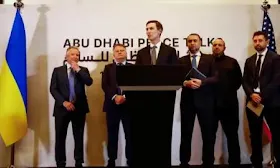
Russia and Ukraine engaged in peace talks in Abu Dhabi, aiming to address post-war security issues. The discussions, however, concluded without achieving a breakthrough.
Quick links: What has happened | Status quo | Confirmed facts | Preconceptions | Elisions | One story, four angles | Related links
What has happened
Russia and Ukraine recently conducted peace talks in Abu Dhabi, aiming to address the ongoing conflict and explore potential pathways towards post-war security. The discussions, however, concluded without a definitive breakthrough, reflecting the complexities surrounding the negotiations between the two nations.
The talks included various high-ranking representatives and focused on security arrangements but did not reach a consensus on specific measures or further plans. Despite the lack of agreement, the engagement in dialogue indicates an ongoing effort both parties are making to discuss their positions and seek a resolution.
Status quo
Russia and Ukraine have recently engaged in peace talks in Abu Dhabi, focusing on post-war security arrangements. However, the discussions concluded without reaching a definitive breakthrough. This meeting is part of ongoing efforts to navigate the complex dynamics of the conflict and explore possible resolutions. Various parties, including international mediators, have been involved in seeking a sustainable peace solution.
Confirmed facts
- Russia and Ukraine held peace talks in Abu Dhabi.
- The talks focused on post-war security issues.
- The discussions ended without a breakthrough.
- Progress was made on prisoner exchanges during the talks.
- The talks were described as being significant but did not resolve ongoing conflicts.
Preconceptions
- BBC prioritizes the outcome of the peace talks, emphasizing the lack of breakthroughs in security agreements, while reducing focus on the specifics of the proceedings.
- CNN highlights the involvement of Trump envoys and the geopolitical implications of talks, emphasizing U.S. strategies rather than direct outcomes from the negotiations themselves.
- The New York Times prioritizes the U.S. urging to include Europe in discussions, emphasizing diplomatic strategies and international cooperation over immediate outcomes of the talks.
- The Guardian reveals progress on prisoner discussions but not on peace, focusing on humanitarian aspects rather than political resolutions similar to BBC’s coverage.
- Overall, while BBC and The Guardian stress outcomes of the talks, CNN and The New York Times focus more on the geopolitical implications and involvement of key political figures, thereby influencing the narrative of coverage significantly.
Elisions
- News coverage highlights that the Russia-Ukraine peace talks in Abu Dhabi progressed on prisoner exchanges but did not yield breakthroughs on peace, a detail notably less emphasized in other sources like CNN, which focused more on diplomatic meetings without detailing specific outcomes.
- BBC and The Guardian reported on the nature of the talks, specifically mentioning that they did not address long-term security arrangements, while CNN and The New York Times largely omitted this critical aspect, instead focusing on the political implications of the talks.
- CNN provided insight into the meeting’s context concerning U.S. diplomatic efforts, noting Trump’s involvement, which The Guardian did not cover; this presents a gap in discussing wider geopolitical dynamics surrounding the talks.
- The New York Times approached the talks with a narrative emphasizing U.S. pressure on Russia to include European stakeholders, a dimension that was not acknowledged by other sources like BBC and CNN, who concentrated on the immediate outcomes of the discussions.
One story, four angles
BBC – Russia-Ukraine talks turn to post-war security but end without breakthrough
Publication: BBC | Intensity: (7/10) | Sentiment: Neutral | Legal precision: Moderate
Expand
Espresso Shot: The headline emphasizes a lack of progress in negotiations, directing focus to the unresolved status of peace initiatives.
Key differences:
1. **Focus on “post-war security”**: BBC presents the talks as forward-looking, highlighting specific areas of concern like security. In contrast, CNN opts for a focus on the failure of breakthroughs.
2. **Use of “end without breakthrough”**: This phrase underlines a stark conclusion, which contrasts with The Guardian’s mention of “progress on prisoners”, shifting the narrative towards partial outcomes.
3. **Attention to negotiation context**: BBC’s framing subtly discusses broader implications of these talks without immediate mention of failures, unlike CNN, which reflects a more critical tone on the lack of resolution.
Bias: Selection: Prioritizes aftermath security over immediate political failures| Language: Uses neutral language to convey the tension | Omission: Does not cover details of participants or specific diplomatic efforts.
Assessment: Readers may initially believe there are significant security discussions underway despite no resolution.
CNN – Trump envoys to meet Putin in Moscow after latest Ukraine talks end with no breakthrough
Publication: CNN | Intensity: (8/10) | Sentiment: Negative | Legal precision: High
Expand
Espresso Shot: The focus is squarely on U.S. political involvement and ongoing failures of peace negotiations, highlighting urgency in the geopolitical landscape.
Key differences:
1. **Emphasis on “Trump envoys”**: This places a political figure at the forefront, contrasting BBC’s more neutral coverage that prioritizes negotiation content over personnel.
2. **“No breakthrough” repetition**: CNN’s repetition stresses failures more heavily compared to other outlets, emphasizing a grim narrative on peace efforts.
3. **Geopolitical urgency**: The headline conveys a sense of immediacy and tension regarding the situation in Ukraine, unlike The Guardian’s more constructive angle on progress.
Bias: Selection: Centers attention on the U.S. political maneuvering | Language: Uses strong, negative adjectives to frame the narrative | Omission: Lacks detail about the context of the discussions among negotiators.
Assessment: Readers may first believe the talks are heavily politicized and fraught with resulting failures.
The New York Times – Seeking to Broaden Ukraine Talks, U.S. Urges Russia to Include Europe
Publication: The New York Times | Intensity: (6/10) | Sentiment: Neutral | Legal precision: Moderate
Expand
Espresso Shot: The headline conveys a diplomatic effort to include European perspectives, hinting at collaboration despite ongoing tensions.
Key differences:
1. **Focus on inclusivity**: The NYT stresses broadening talks to include Europe, positioning the U.S. as a diplomatic force, while CNN stresses the failure to secure agreements, producing a blame-focused atmosphere.
2. **Language of “urges” vs. “end without breakthrough”**: This softer language encourages a sense of progress over defeat, contrasting the CNN approach on an absolute failure perspective.
3. **Framework of collaboration**: Highlighting a desired cooperative effort differs from BBC’s framing of security, indicating hope amidst volatility, while CNN emphasizes failure strictly.
Bias: Selection: Highlights diplomatic efforts over failures | Language: More optimistic language approaches | Omission: Lacks detail on what specific European contributions are sought in negotiations.
Assessment: Readers might believe that diplomatic efforts are ongoing with optimism for collaborative discussions.
The Guardian – Ukraine talks in Abu Dhabi bring progress on prisoners but not on peace
Publication: The Guardian | Intensity: (7/10) | Sentiment: Neutral | Legal precision: Moderate
Expand
Espresso Shot: The Guardian’s focus is on humanizing the talks by highlighting progress concerning prisoners, setting a contrasting tone to political stalemate narratives.
Key differences:
1. **Highlighting humanitarian progress**: The mention of prisoners shows a more human aspect, unlike CNN’s harsh focus on political standoffs.
2. **The balance of hope and failure**: By stating “brought progress on prisoners”, it implies potential for future talks, unlike BBC’s more guarded tone without this nuance.
3. **Less political framing**: Guardian’s angle offers a narrative less centered on international power plays, instead portraying a glimpse of compassion amid the negotiations.
Bias: Selection: Emphasizes humanitarian progress rather than political failure | Language: More compassionate towards negotiation outcomes | Omission: Lacks discussion on broader implications of successful prisoner negotiations for ongoing talks.
Assessment: Readers might initially perceive that despite the lack of overall peace, there are meaningful humanitarian efforts taking place.
In analyzing recent coverage of the Russia-Ukraine peace talks, BBC captures the essence of diplomatic progress while noting a lack of breakthroughs, presenting a balanced view. In contrast, CNN’s framing is more escalatory, emphasizing the ongoing tensions and the failure to reach consensus amidst increased scrutiny of the involved parties. The New York Times takes a nuanced approach, suggesting the U.S. is actively promoting inclusive dialogue, whereas The Guardian focuses on specific developments regarding prisoners, subtly hinting at the complexities of the negotiations. The facts do not change. What changes is where scrutiny lands.
Related links
BBC
Russia-Ukraine talks turn to post-war security but end without breakthrough
CNN
Trump envoys to meet Putin in Moscow after latest Ukraine talks end with no breakthrough
The New York Times
Seeking to Broaden Ukraine Talks, U.S. Urges Russia to Include Europe
The Guardian
Ukraine talks in Abu Dhabi bring progress on prisoners but not on peace








Great article! This really puts things into perspective. I appreciate the thorough research and balanced viewpoint.
Interesting read, though I think there are some points that could have been explored further. Would love to see a follow-up on this topic.
Thanks for sharing this! I had no idea about some of these details. Definitely bookmarking this for future reference.
Well written and informative. The examples provided really help illustrate the main points effectively.
This is exactly what I was looking for! Clear, concise, and very helpful. Keep up the excellent work!