

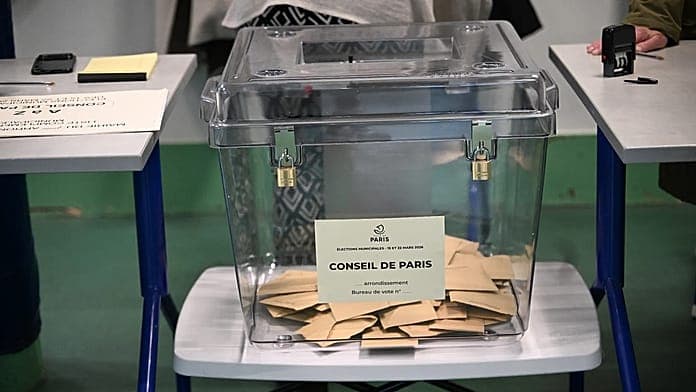
Polling stations open across France as nearly 900,000 candidates compete
Polling stations across mainland France and Corsica opened at 8:00 am for the local elections, with nearly 900,000 candidates competing.
President Emmanuel Macron‘s party, Renaissance, faces difficulties in establishing a local presence amid rising competition from the National Rally and internal left-wing conflicts.
Polling stations will close gradually between 6:00 pm and 7:00 pm local time, with first results expected after 8:00 pm.
Briefing summary
Polling stations opened across France at 8:00 am, with 48.7 million voters eligible to participate in the local elections. Results will be released after 8:00 pm local time.
Nearly 900,000 candidates are competing in the elections, with expected swift outcomes in the majority of municipalities due to limited competition and many incumbents choosing not to seek re-election.
The national political landscape is closely observed, with President Emmanuel Macron’s party, Renaissance, struggling locally while the National Rally aims for gains. Key cities, including Paris and Marseille, face competitive races.
French voters head to the polls for the first round of local elections
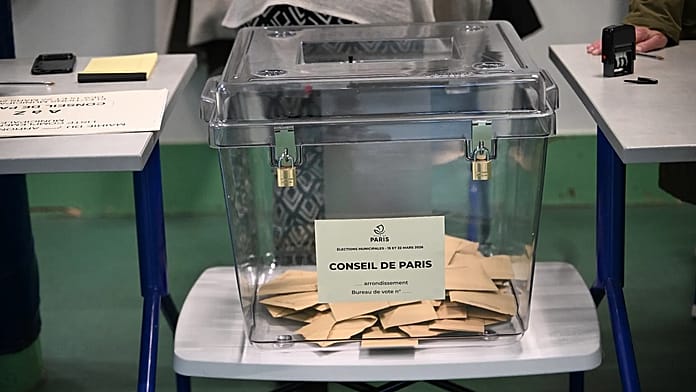
In total, 48.7 million voters are eligible to cast their ballots across some 35,000 municipalities, from small rural villages to major cities.
Polling stations opened at 8:00 am in mainland France and Corsica.
The first results cannot be published before 8:00 pm local time, when polling stations close in the largest cities.
Elsewhere, the polls will close gradually between 6:00 pm and 7:00 pm.
Voter turnout under scrutiny
Voter participation will be one of the key indicators of this local election.
In 2020, the first round of municipal elections took place in exceptional circumstances, just days before France entered its first nationwide lockdown due to COVID-19, which significantly affected turnout.
This time, abstention rates will be closely analysed as a potential sign of democratic fatigue.
However, French mayors remain among the country’s most trusted political figures, according to several opinion polls.
Nearly 900,000 candidates
According to figures from the Interior Ministry, around 900,000 candidates are competing in the first round, across nearly 50,000 candidate lists.
In most municipalities, however, the outcome could be known quickly.
In almost 32,000 out of 35,000 municipalities, the mayor is expected to be elected in the first round.
This is largely due to the limited number of competing lists: in 68% of municipalities, only one candidate list has been registered.
By contrast, some cities are seeing intense competition. Montpellier in southern France holds the record with 13 lists registered for the first round.
In 68 municipalities, no candidates have come forward. In these cases, the state’s local representative — the prefect — will appoint an interim administration until a new election can be organised or, in some cases, until the municipality merges with a neighbouring one.
Another notable trend is the decline in the number of incumbents seeking re-election.
What is at stake?
While the outcome already appears clear in most municipalities, several major cities could see fiercely contested second rounds.
In Paris, the race to succeed outgoing mayor Anne Hidalgo is expected to be particularly tight, with a heated contest between Rachida Dati, candidate of the conservative party Les Républicains, and Emmanuel Grégoire from the Socialist Party.
Uncertainty is also high in Marseille, Nice, Nantes and Toulouse, where several candidate lists are expected to qualify for the second round.
President Emmanuel Macron’s party, Renaissance, meanwhile, continues to struggle to establish a strong local presence across the country.
On the far right, the National Rally (RN) hopes to make new gains at the local level.
At the same time, tensions between former allies in the left-wing New Popular Front coalition, particularly between the Socialist Party and the hard-left party La France Insoumise, have shaped much of the campaign.
Although municipal elections primarily focus on local governance — such as urban planning, schools and local services — their national political implications are difficult to ignore, with just over a year to go before France’s next presidential election.











Great article! This really puts things into perspective. I appreciate the thorough research and balanced viewpoint.
Interesting read, though I think there are some points that could have been explored further. Would love to see a follow-up on this topic.
Thanks for sharing this! I had no idea about some of these details. Definitely bookmarking this for future reference.
Well written and informative. The examples provided really help illustrate the main points effectively.
This is exactly what I was looking for! Clear, concise, and very helpful. Keep up the excellent work!