

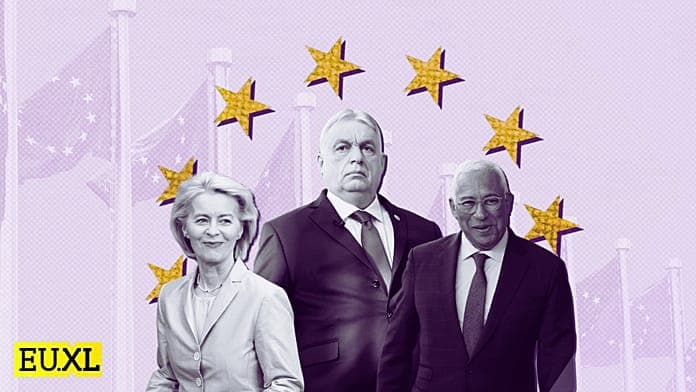
Hungary uses EU veto power to extract concessions on unrelated issues
Member states can veto EU decisions in key areas such as foreign policy and taxation, reflecting their status as a union of sovereign states.
Hungary has exercised its veto 21 times on key geopolitical issues since 2011, highlighting the challenges of reform within an EU reliant on consensus decision-making.
“No government should be forced into decisions that cut against its fundamental interests,” emphasised a spokesperson on the implications of veto powers in the EU.
Key developments
Under EU treaties, member states retain the right to veto decisions affecting core sovereignty areas such as foreign policy and taxation, which complicates regional governance.
Hungary has employed its veto 21 times on 38 issues since 2011, citing sovereignty concerns to justify its opposition to aid for Ukraine and sanctions on Russia.
Despite calls for reform, abolishing the veto power requires unanimous agreement, hindering progress on establishing formal safeguards to clarify its legitimate use.
Is the EU done with member states using vetoes as a power move?

Under EU treaties, member states can veto decisions in areas that touch their core sovereignty: foreign policy, taxation, enlargement, and the budget. Under the EU treaties, the bloc is a union of sovereign states, not a federation, and no government should be forced into decisions that cut against its fundamental interests.
The problem is what happens when it’s used to extract concessions.
There are no formal safeguards to differentiate between a legitimate sovereignty veto, and one used as leverage on unrelated issues. Member states consistently present each veto as a matter of sovereignty protection. For example, Hungary has vetoed aid to Ukraine or sanctions against Russia (21 times across 38 issues since 2011), officially justifying these actions in the same manner as other countries.
Yet abolishing the veto requires unanimity, locking the bloc in a cycle where reform seems out of reach.














Great article! This really puts things into perspective. I appreciate the thorough research and balanced viewpoint.
Interesting read, though I think there are some points that could have been explored further. Would love to see a follow-up on this topic.
Thanks for sharing this! I had no idea about some of these details. Definitely bookmarking this for future reference.
Well written and informative. The examples provided really help illustrate the main points effectively.
This is exactly what I was looking for! Clear, concise, and very helpful. Keep up the excellent work!