

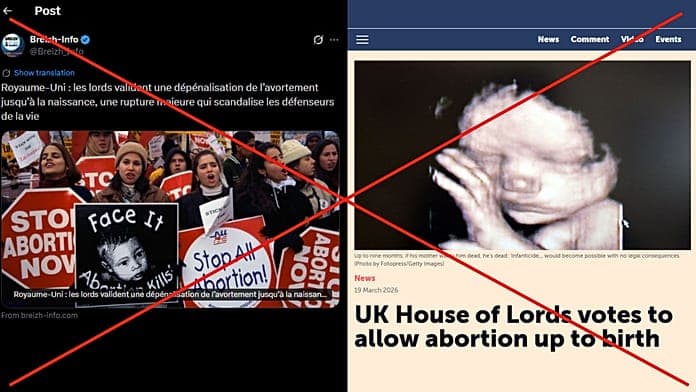
House of Lords votes to decriminalise abortion for women in England
On 18th March, the House of Lords voted to decriminalise women who terminate their pregnancies, shielding them from criminal investigations or prosecutions.
More than 100 women have faced criminal investigations under current laws, underscoring the significant implications of the House of Lords’ decision to decriminalise abortions outside the legal framework.
“The House of Lords has approved a necessary amendment to decriminalise women facing criminal liability for terminating their pregnancies,” a spokesperson affirmed.
Key developments
On 18 March, the House of Lords voted to back an amendment to the Crime and Policing Bill, which aims to decriminalise abortions, removing liability for women terminating pregnancies outside legal frameworks.
This reform will not alter existing legal requirements, which stipulate that two doctors must certify an abortion’s necessity before 24 weeks. Exceptional circumstances permit procedures post-24 weeks.
More than 100 women have faced investigations under the 1861 Offences Against the Person Act in recent years, prompting calls for legal reform to prevent future prosecutions.
Misleading headlines claim UK legalised abortion until birth
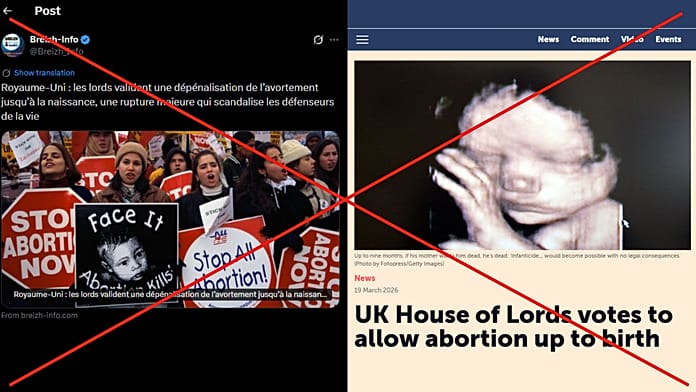
On the 18th of March, the British Parliament’s upper house, known as the House of Lords, voted to end the criminalisation of women who terminate their pregnancies up until the moment of birth.
Online articles also repeated the claim, which spread widely on X and Facebook, with some posts attracting thousands of views and shares.
But the House of Lords did not vote to legalise abortion until birth, but rather to keep an amendment that the British Parliament’s lower house, known as the House of Commons, voted in favour of last year that would remove women who choose to have abortions outside of the legal framework from criminal liability.
This means that women would no longer face criminal investigation, arrest, or prosecution for ending their own pregnancies. It also means that women who have been convicted, or even jailed, over abortions outside of the legal framework will be pardoned.
It concerns an amendment to the Crime and Policing Bill and has yet to complete its final passage through parliament.
The Act says women who wish to terminate their pregnancies must have two doctors certify that the procedure is necessary for the pregnant person’s health, up to a 24-week limit.
Beyond this time-frame, healthcare professionals are only legally able to provide an abortion in exceptional circumstances, such as a severe fetal abnormality or a grave risk to the life of the mother.
Part of the confusion online seems to stem from conflating the terms “decriminalisation” and “legalisation”. In this case, the House of Lords has backed a reform that would decriminalise women ending their own pregnancies while keeping the broader legal framework in place.
In recent years, more than 100 women have reportedly faced criminal investigations under the 1861 Offences Against the Person Act, prompting calls from campaigners and some lawmakers to update the law and prevent further prosecutions.
How does the EU compare?
Most EU member states have legalised abortion “on request” during the first trimester. Meanwhile, a small group – including Denmark, Estonia, Luxembourg, the Netherlands, and Sweden – have liberal abortion regimes that resemble full decriminalisation, although some limitations apply.
The World Health Organization recommends full decriminalisation, including the removal of gestational time limits, and the elimination of barriers like mandatory waiting periods or third-party authorisation.
On the other hand, in countries like Germany and Switzerland, abortion remains technically illegal under criminal law but is permitted under certain conditions, including a waiting period and mandatory counselling.
Either way, it’s a patchwork landscape that continues to evolve: in April 2024, the European Parliament passed a resolution calling for the EU Charter of Fundamental Rights to be amended to include the right to safe and legal abortion.
This vote urged all member states to fully decriminalise the procedure and remove remaining physical, financial and regulatory barriers to reproductive healthcare.
Following that vote, the resolution stalled at the legislative level because any changes to the EU Charter of Fundamental Rights require unanimous agreement from all member states, which has not been reached because of strong opposition from countries like Malta and Poland.













Great article! This really puts things into perspective. I appreciate the thorough research and balanced viewpoint.
Interesting read, though I think there are some points that could have been explored further. Would love to see a follow-up on this topic.
Thanks for sharing this! I had no idea about some of these details. Definitely bookmarking this for future reference.
Well written and informative. The examples provided really help illustrate the main points effectively.
This is exactly what I was looking for! Clear, concise, and very helpful. Keep up the excellent work!