

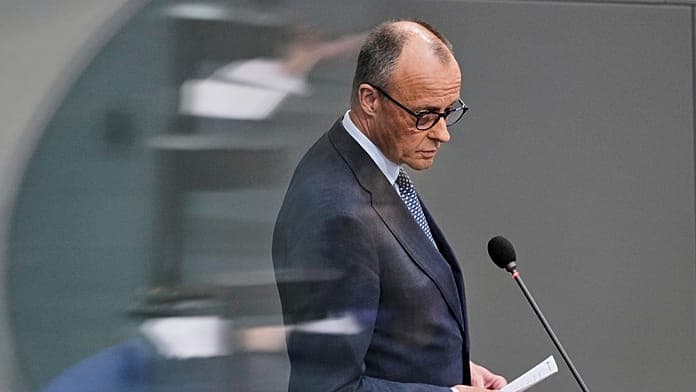
European Commission rejects Germany’s call for China trade deal
The European Commission dismissed German Chancellor Friedrich Merz’s proposal for an EU-China trade deal, urging Beijing to address its distortive economic practices.
Germany recorded a record-high trade deficit with China worth €89 billion last year, illustrating significant economic imbalance within the EU’s trade dynamics.
“We want to have the strongest and most mutually beneficial possible trade and investment relationship with China,” stated Olof Gill, European Commission spokesperson for trade policy.
Key developments
The European Commission has firmly rejected German Chancellor Friedrich Merz’s proposal for a trade deal with China, insisting that Beijing must address its economic distortions first.
Olof Gill, the Commission’s spokesperson, highlighted ongoing EU concerns about China’s state-driven economic practices, including industrial overcapacity and significant market access restrictions.
Not so fast: Brussels snubs Merz’s suggestion for EU-China trade deal
Published on
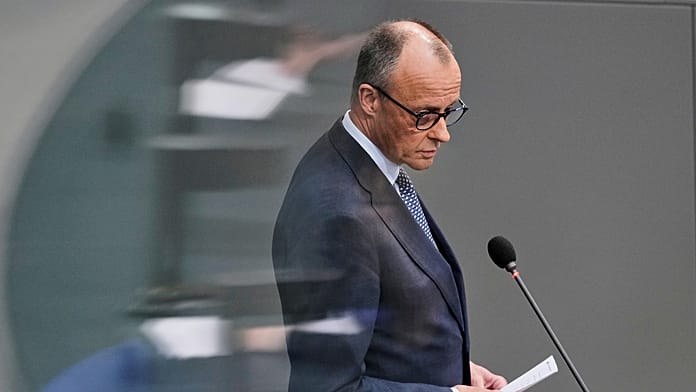
The European Commission has cast aside German Chancellor Friedrich Merz’s suggestion to pursue a trade deal between the European Union and China, calling instead on Beijing to “meaningfully” address its distortive economic practices.
The bloc, like most developed economies, is struggling to contain a ballooning trade deficit with China, which has turned to low-cost exports to offset a persistent real estate crisis and sluggish consumer demand. The imbalance has raised serious concerns of unfair competition, industrial decline and mass unemployment across Europe.
“We want to have the strongest and most mutually beneficial possible trade and investment relationship with China,” Olof Gill, the Commission’s spokesperson for trade policy, said on Thursday afternoon, in response to a EU News question.
“But in order for that to happen, there are a number of concerns and real challenges that the European Union has consistently expressed to China that we need to see them meaningfully addressed before we can even talk about any future agreements or anything like that,” Gill added.
Brussels has for years complained about the harmful effects of Beijing’s state-run economic model, such as industrial overcapacity, extensive subsidies, market access restrictions, forced technology transfer and punishing export controls.
“We’re focused on engaging with China in order to hear from them in a constructive (and) meaningful way how they propose to address the many challenges in our trade and investment relationship that we continuously flag,” Gill said.
‘Urgent response’
Merz unexpectedly floated his idea for a trade deal with China on Wednesday during a Q&A session at the Bundestag, the lower house of the German parliament. The suggestion was framed as a future possibility, rather than an immediate project.
“I can envision further agreements, for example, in the longer term, an agreement with the People’s Republic of China. We now need strategic partnerships worldwide to strengthen ourselves, especially in exports.”
Merz’s remarks stand in contrast with the tone he adopted in February when he visited Beijing and said the imbalance between Germany and China was “not healthy”.
Last year, Germany recorded a record-high trade deficit with China worth €89 billion. None of the 27 EU member states saw a surplus with the Asian giant.
By suddenly suggesting a trade deal, Merz seems to soften his stance, reflecting Germany’s reluctance to confront one of its main trading partners.
“We cannot and will not absorb China’s export-led growth model, and its industrial overcapacity,” von der Leyen said earlier this week while visiting Australia.
“Both the threat to our supply-chain security and the shock to our industrial base need urgent responses. These are responses we can only devise together.”
In a letter to von der Leyen, Belgian Prime Minister Bart De Wever urgeda tougher strategy to tackle the Chinese challenge, even if it means suffering retaliation.
“We have reached a point of no return where we must make difficult choices in the short term to protect our industry, economy and the well-being of our citizens in the long term,” De Wever said.






Great article! This really puts things into perspective. I appreciate the thorough research and balanced viewpoint.
Interesting read, though I think there are some points that could have been explored further. Would love to see a follow-up on this topic.
Thanks for sharing this! I had no idea about some of these details. Definitely bookmarking this for future reference.
Well written and informative. The examples provided really help illustrate the main points effectively.
This is exactly what I was looking for! Clear, concise, and very helpful. Keep up the excellent work!