

EU rejects US claims of exporting industrial overcapacity amidst trade tensions
The European Commission rejected US accusations of exporting industrial overcapacity, amid new investigations and concerns over the Turnberry trade deal’s integrity.
American Chamber of Commerce to the EU calls for both parties to honour commitments under the Turnberry agreement to minimise trade dispute escalations.
New US investigations are targeting the EU under Section 301 as the White House seeks to impose tariffs amid ongoing trade tensions following the court ruling.
Briefing summary
The European Commission rejected claims of exporting industrial overcapacity to the US following new trade investigations targeting the EU. It emphasised that excess capacity issues stem from other markets, particularly China.
In response to a recent US Supreme Court ruling, Washington announced further investigations under Section 301, designating the EU among its trading partners. This move aims to address perceived restrictions on US commerce.
The Commission has urged the US to adhere to the Turnberry agreement, warning that ongoing tariff escalations could jeopardise the deal. EU trade chief Maroš Šefčovič has engaged US officials to ensure commitments are upheld amid increasing uncertainty.
Read in Full
Commission denies unfair trade practices as US opens new probe
Published on
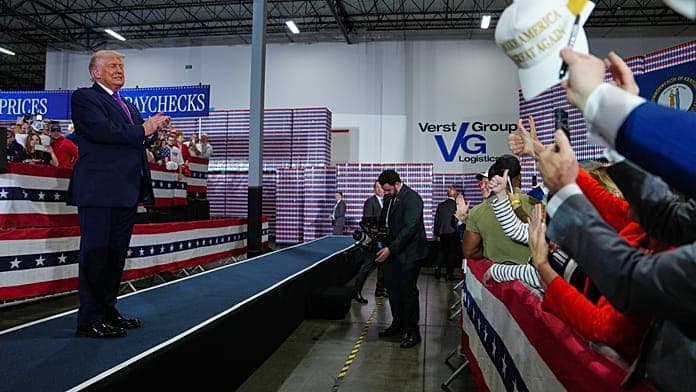
The European Commission on Thursday rejected accusations that it exports industrial overcapacity to the US, after Washington launched fresh trade investigations targeting the EU and other partners over alleged unfair practices related to excess production.
Following a February US Supreme Court ruling that 2025 tariffs were illegal, the White House is seeking new legal grounds to impose new duties as part of its nationalist trade policy.
But EU officials had already warned the move could undermine last summer’s lopsided Turnberry trade deal, which the Commission considered its best possible outcome.
“The sources of such overcapacity are well identified, and they do not lie in Europe,” Commission deputy spokesperson Olof Gill said, noting that Chinese industrial surpluses are often cited as a global trade concern. He added: “The EU is a market-driven economy with open markets and transparent policies. As such, the EU does not consider itself a contributor to structural excess capacity, but rather a partner in addressing global distortions.”
The US announced Wednesday new investigations under Section 301 targeting trading partners including the EU. The provision can be used “to respond to unjustifiable, unreasonable, or discriminatory foreign government practices that burden or restrict US commerce.”
US Trade Representative Jamieson Greer said excess manufacturing capacity was harming the US industrial base, displacing “existing US domestic production or prevents investment and expansion in US manufacturing production that otherwise would have been brought online.”
“The United States will no longer sacrifice its industrial base to other countries that may be exporting their problems with excess capacity and production to us,” he said.
Washington has already imposed new tariffs of 10% following the court ruling, on top of the 4.8% duties that were in place before US President Donald Trump returned to power in 2025.
The Commission wants the US to stick to the Turnberry agreement
The Commission estimated that 7% of EU exports now face tariffs exceeding the 15% cap that Washington committed to under last summer’s trade deal, prompting Brussels to call on the US to honour the agreement.
EU trade chief Maroš Šefčovič has held several calls with US counterparts since the court ruling, including Monday’s conversation with US Treasury Secretary Scott Bessent, in which Washington repeatedly assured that it would respect the deal if the EU upheld its commitments.
With those assurances in hand, the Commission has urged MEPs to lift the freeze on implementing the agreement, which has been stalled since Trump threatened tariffs linked to Greenland. The deal would see the EU cut tariffs to zero on most US industrial goods entering Europe.
But lawmakers have repeatedly said they need greater clarity from Washington following the court ruling.
“We knew US Section 301 investigations were coming,” German MEP Bernd Lange (S&D), chair of the European Parliament’s trade committee, wrote on X. “Nevertheless, uncertainty remains. There is still no clear commitment from the US government to uphold the Turnberry commitments.”
The American Chamber of Commerce to the European Union said it hopes both sides will “avoid escalation in the trade dispute.”
“The priority must be to restore stability and predictability in transatlantic trade,” the Chamber said in a statement. “The deal struck in the summer is not a perfect solution, but it offers the most realistic path forward given political priorities on both sides. We look to the parties to honour their commitments under the EU-US Framework Agreement.”
Gill told reporters the Commission still plans to stick to the agreement and expects the US to do the same. If that were not the case, “the Commission would respond firmly and proportionately,” he added.





Great article! This really puts things into perspective. I appreciate the thorough research and balanced viewpoint.
Interesting read, though I think there are some points that could have been explored further. Would love to see a follow-up on this topic.
Thanks for sharing this! I had no idea about some of these details. Definitely bookmarking this for future reference.
Well written and informative. The examples provided really help illustrate the main points effectively.
This is exactly what I was looking for! Clear, concise, and very helpful. Keep up the excellent work!