

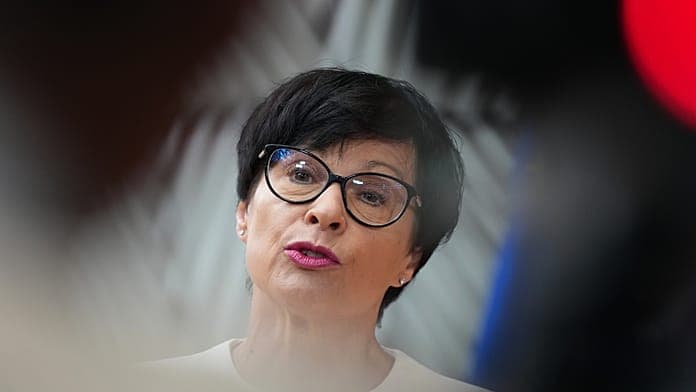
EU commissioner urges member states to open accession talks for Ukraine
Marta Kos has urged EU member states to open all negotiation clusters for Ukraine and Moldova by July, citing a renewed opportunity with Hungary’s new authorities.
Brussels is poised to intensify EU accession negotiations for Ukraine and Moldova, potentially unlocking six negotiation clusters by July under new Hungarian leadership.
“I will urge all member states to formally open all the clusters,” stated Marta Kos, emphasising readiness for the EU accession negotiations with Ukraine and Moldova.
Key developments
Marta Kos has urged member states to open all EU accession negotiation clusters for Ukraine and Moldova by July, citing a renewed opportunity following changes in Hungary’s leadership.
The European Commission expects Ukraine to receive the first tranche of a €90 billion loan next week, as Hungary has lifted its veto, improving prospects for EU integration.
EU’s Kos sets July deadline for Ukraine accession clusters
Published on •Updated
Marta Kos has urged member states to open all EU accession negotiation clusters for Ukraine and Moldova by July, in a renewed push to break months of deadlock, as Brussels sees a window of opportunity with Hungary’s new authorities.
“I will urge all member states to formally open all the clusters,” she told reporters in Brussels on Monday. “We have done a lot of front-loading, so everything is ready (for it).”
Kos said the first negotiation cluster could be opened in June during Cyprus’s rotating EU presidency, with the remaining five to follow by July once Ireland takes over the role. The Commissioner also said she expects Ukraine to receive the first tranche of a €90 billion loan backed by EU member states next week after Hungary lifted a months-long veto.
Negotiating clusters are linked to major reforms in alignment with EU standards, from rule of law to judicial reform. All benchmarks must be met by an aspiring country, with the final decision resting on unanimous approval by the 27 member states.
The European Commission argues that Ukraine is technically ready to begin the process, which has so far been dragged by Hungary’s veto policy under Prime Minister Viktor Orbán. With a change in leadership, Brussels hopes Budapest will take a more constructive approach to accelerate Kyiv’s path towards membership.
Magyar, who was sworn in as prime minister on 9 April, coinciding with Europe Day, has defended Ukraine’s territorial integrity under international law but has rejected any fast-track path to EU membership, a view shared by most member states.
While the Commission has praised Ukraine’s progress, it has refused to set a date for its membership, insisting the process remains merit-based. Kyiv, meanwhile, is pushing for a clear timetable to be set down on paper as soon as possible.
The June deadline set by Kos for the first cluster coincides with Magyar’s first European summit as Hungarian prime minister, scheduled for mid-June. While opening clusters does not require leaders’ approval and can be handled by diplomats, the summit is seen as a temperature check for Kyiv, Brussels and Budapest.
Magyar has indicated that a reset in relations is possible, but has made it conditional on Kyiv introducing legal changes to protect what he described as the linguistic, cultural and historical rights of ethnic Hungarians in Ukraine. A meeting between Magyar and Ukrainian President Volodymyr Zelenskyy is expected in early June.







Great article! This really puts things into perspective. I appreciate the thorough research and balanced viewpoint.
Interesting read, though I think there are some points that could have been explored further. Would love to see a follow-up on this topic.
Thanks for sharing this! I had no idea about some of these details. Definitely bookmarking this for future reference.
Well written and informative. The examples provided really help illustrate the main points effectively.
This is exactly what I was looking for! Clear, concise, and very helpful. Keep up the excellent work!