


EU agrees on new law to expand deportation powers for migrants
EU countries will be allowed to establish deportation centres outside the bloc, under new provisions allowing irregular migrants to be returned to third countries.
The EU plans to establish deportation hubs in third countries, allowing returns without ties to migrants’ countries of origin, fundamentally altering current policies.
“We will ensure that those who have no right to stay in the EU are actually returned,” stated EU Home Affairs Commissioner Magnus Brunner during the law’s presentation.
EU set to back return hubs in toughest migration crackdown yet
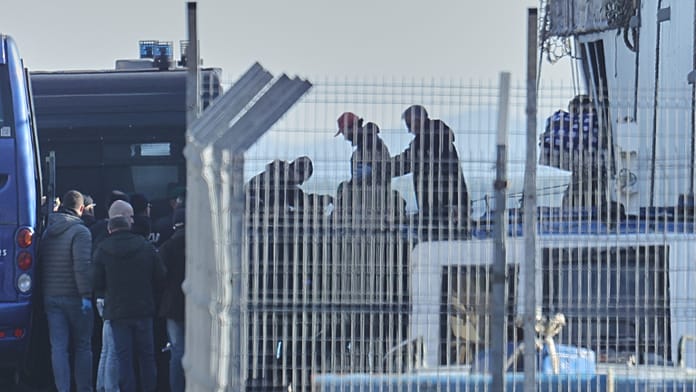
The European Union is preparing to dramatically expand its deportation powers, with a landmark law allowing migrants to be sent to return hubs outside Europe and making it easier for governments to remove people with no right to stay.
A deal on the Return Regulation is expected today between EU governments and the European Parliament, marking the most hardline turn in EU migration policy in decades. Driven by political pressure over migration and the rise of anti-immigration parties, Brussels is embracing measures that would have been unthinkable only a few years ago.
The new law aims to raise the return rate, as currently, around 28% of migrants ordered to leave are effectively returned outside Europe. EU governments and institutions are pushing for more control over who can stay in the EU and who must leave, reflecting polls showing European voters increasingly worried about uncontrolled migration flows.
“We will ensure that those who have no right to stay in the EU are actually returned,” EU Home Affairs Commissioner Magnus Brunner promised when he presented the law.
The topic is likely to hang over upcoming elections across EU countries, fuelling the rise of far-right forces such as National Rally in France and Vox in Spain, despite data showing a substantial drop in irregular arrivals in 2026 and 2025.
Together with the tougher rules for asylum and easier deportations, the legislation underscores how EU migration policy has shifted under Ursula von der Leyen‘s second term. The focus has moved from managing migration within the bloc to speeding up the removal of people with no right to remain in Europe.
Return hubs kick off the “era of deportations”
At the heart of the law is a provision allowing EU countries to establish deportation centres outside the bloc, alongside longer detention periods, tougher entry bans and new powers to locate irregular migrants.
“The era of deportations has begun,” said Swedish right-wing conservative lawmaker Charlie Weimers, who is among the negotiators of the law, when the Parliament first approved it.
EU countries will be allowed to return irregular migrants to third countries unrelated to their origin, as long as they have bilateral agreements in place with a non-EU state to build so-called “return hubs” on their territory. The hubs can be either places of transit or locations where a person is expected to stay.
The measure marks a significant departure from current rules. Today, migrants can generally only be returned to their country of origin or to a country with which they have a proven connection. Under the new system, that requirement would be removed. Families with children could be transferred to return hubs, although unaccompanied minors would be exempt.
Human rights groups have strongly criticised the proposal, warning that it risks leaving migrants stranded in countries where they have no ties and few legal protections.
Over 250 civil society organisations have called for the regulation to be rejected. “The EU is legitimising offshore prisons, racial profiling and child detention in ways we have never seen,” Sarah Chander, Director at the Equinox Initiative for Racial Justice, said.
Critics also claim these centres will have little impact on the migration flows and return pace. The Italian government is already running a similar project in Albania, with two centres accommodating fewer than a hundred migrants in total, despite the initial plan being to host 36,000 people every year.
Despite the controversy, several governments are pressing ahead. Italy is already operating a similar scheme in Albania, while Germany, the Netherlands, Austria, Denmark and Greece teamed up to identify potential partner countries for future return centres.
What is in the new regulation
National authorities in the EU member states will also be allowed to search irregular migrants’ “place of residence or other relevant premises”, a provision that has been compared by NGOs and civil society to the notorious raids conducted by the US Immigration and Customs Enforcement.
Another major change concerns appeals. Under current rules, deportations are automatically suspended while legal challenges are pending. The new law would end that automatic protection, leaving courts to decide on a case-by-case basis whether a return order should be halted.
The new law will increase as well the maximum legal detention period for irregular migrants waiting to be returned from six months to two years, with an unlimited duration for persons considered as posing a security risk.
Entry bans would also become significantly tougher, rising from five to ten years in most cases, with the possibility of lifetime bans for those considered a security risk.
Negotiators from EU countries and the EU Parliament are set to kick off the discussion at 6 pm in Brussels. They are fully aligned on the law’s content and only disagreed on the timeframe to enforce the law during the last talks in Strasbourg.
After an agreement is reached, the final text will need to be formally approved by MEPs and EU countries.











Great article! This really puts things into perspective. I appreciate the thorough research and balanced viewpoint.
Interesting read, though I think there are some points that could have been explored further. Would love to see a follow-up on this topic.
Thanks for sharing this! I had no idea about some of these details. Definitely bookmarking this for future reference.
Well written and informative. The examples provided really help illustrate the main points effectively.
This is exactly what I was looking for! Clear, concise, and very helpful. Keep up the excellent work!