

Get you up to speed: Alabama pushes US Supreme Court to approve congressional map for midterms
Republicans in Alabama have petitioned the United States Supreme Court to approve a congressional map previously ruled racially discriminatory. The state’s Republican leadership is seeking a decision by Monday to enable the map’s use for the upcoming 2026 midterm elections.
Alabama Republicans are urging the United States Supreme Court to render a decision by Monday regarding the approval of a congressional map, initially rejected in 2023, to be used for the 2026 midterm elections. Following previous rulings that deemed the map racially discriminatory, the state plans to conduct new primaries on August 11 if the Supreme Court permits the map’s implementation.
Alabama Republicans have formally petitioned the US Supreme Court, urging a ruling by Monday to reinstate a congressional map previously deemed racially discriminatory, asserting that failing to do so could lead to “irreparable harm” in their redistricting efforts. If approved, Governor Kay Ivey has indicated that new primaries will be scheduled for August 11 in four congressional districts to reflect the proposed changes.
What remains unclear — It is uncertain how the recent Supreme Court ruling will influence the final decision on Alabama’s congressional map ahead of the midterms.
Alabama petitions Supreme Court for approval of rejected congressional map
News|US Midterm Elections 2026Alabama pushes US Supreme Court to approve congressional map for midterms
Republicans have revived a push to implement a congressional map that was rejected in 2023 for racial discrimination.
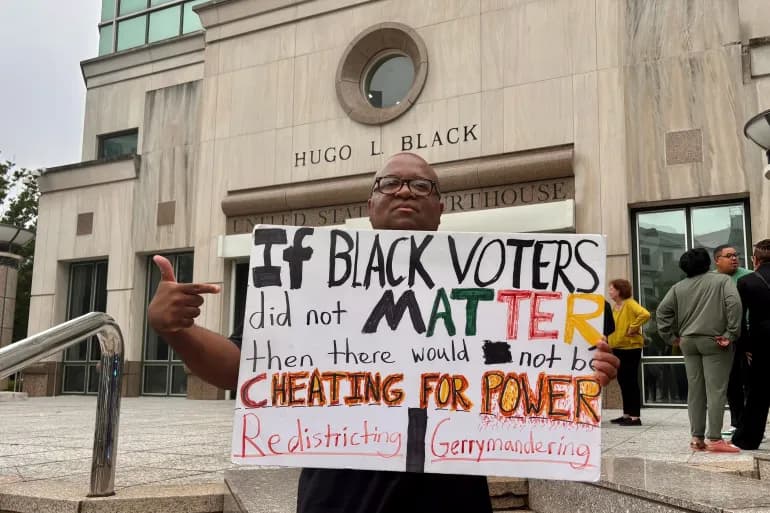
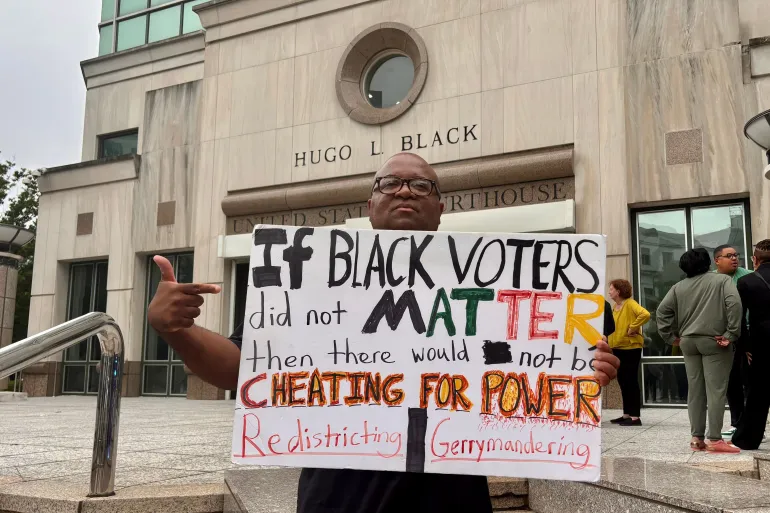 Travis Jackson protests for voting rights outside the federal court in Birmingham, Alabama, on May 22 [Kim Chandler/AP Photo]
Republicans in the southern state of Alabama have petitioned the United States Supreme Court to approve a congressional election map previously ruled to be racially discriminatory.
On Wednesday, the state’s Republican leadership called on the high court to rule by Monday so that the map could be used for the 2026 midterm elections.
list of 3 itemslist 1 of 3Virginia Supreme Court strikes down Democrats’ redistricting plan in USlist 2 of 3Why Louisiana paused its US House primary election amid redistricting pushlist 3 of 3A redistricting re-do? What to know about Alabama’s primary electionsend of list
Previously, in 2023, the Supreme Court had declined to reverse a lower court decision, which found that the map violated prohibitions against racial discrimination under the Voting Rights Act of 1965.
That law had long been one of the few limits to partisan redistricting, also known as gerrymandering.
While no law currently prohibits lawmakers from redesigning congressional maps to give their parties an advantage, the Voting Rights Act included a section that bars politicians from limiting government representation based on race or minority status.
But last month, in the case of Louisiana v Callais, the US Supreme Court weakened how the Voting Rights Act could be applied to redistricting cases.
States like Alabama have since moved to reapply congressional maps that had previously been struck down on grounds of racial discrimination.
Alabama’s redistricting push
In Alabama’s case, a three-judge panel in 2023 found that the state’s Republican leadership had intentionally diminished the political strength of Black voters, who tend to lean Democratic.
The panel ruled that the state should have two Black-majority districts: one that includes the city of Birmingham, and another that includes the state capital, Montgomery.
But in Wednesday’s court filing, Alabama Republicans argued that the panel’s ruling was no longer valid, given the April Supreme Court decision.
It instead pushed for the map that was rejected in 2023 to be restored, consolidating most of the state’s Black voters into a single district.
In their request to the Supreme Court, the Republican leaders asserted that urgent action was necessary to prevent “irreparable harm” to their partisan redistricting push.
“Worse still, voters will be forced to vote under a court-drawn racially gerrymandered map that does not meet Alabama’s legitimate districting goals,” they wrote.
Should the rejected map be restored, Governor Kay Ivey has already indicated that new primaries will be held in four of the state’s seven congressional districts to reflect the new boundaries.
Primaries had already been held across the state on May 19, but voters in Alabama’s first, second, sixth and seventh congressional districts would have to recast their ballots under the plan on August 11.
The winners of those primaries would then proceed to compete in November’s midterm elections.
But the Republican-led push to redraw the congressional map hit a hurdle on Tuesday, when a lower court once again rejected the 2023 map.
“The court saw through Alabama’s blatant attempt to reinstate a race-based congressional map that the legislature deliberately enacted to deny Black voters a voice in Congress,” the plaintiffs said in a statement on Tuesday, released by the American Civil Liberties Union (ACLU).
New maps nationwide
The battle over Alabama’s congressional districts reflects the hotly contested race to control the US House of Representatives in November’s midterm elections.
Republicans hold both chambers of Congress by slim majorities. As a result, the outcome of a handful of elections could sway both chambers either left or right.
Currently, 217 Republicans form the House’s majority, out of 435 possible seats.
Last year, with November’s midterm elections on the horizon, Republican President Donald Trump launched a push for his party to corner the advantage.
In June 2025, reports began to emerge that the Trump White House had contacted Texas state legislators to encourage them to pass new congressional maps, which would cluster voters in a way to lessen the likelihood of Democratic victories.
Normally, redistricting happens once a decade, to reflect population changes captured by the census.
But the decision by Texas Republicans to push forward with Trump’s plan and redesign the state’s congressional map triggered a nationwide redistricting fight.
In August, Texas passed a new map drawn to help Republicans score five more House seats in the midterms.
California, a Democratic stronghold, responded by putting a ballot initiative before voters to redesign its congressional districts to help left-wing candidates increase their victories, too. That proposal passed in November 2025.
Other states have followed suit. In the wake of the April Supreme Court decision, Tennessee has moved to reshape its congressional map to break up a Democratic district containing the city of Memphis, while Louisiana Republicans have also announced their intentions to redraw its map.
Some states, however, have refused Trump’s midterm redistricting push. South Carolina, for instance, punted on a redistricting proposal earlier this week, as early voting for party primaries began in the state.
Trump, however, has framed the outcome of the midterm races as an existential crisis for his presidency.
“You’ve got to win the midterms because, if we don’t win the midterms, it’s just going to be — I mean, they’ll find a reason to impeach me,” he told Republican leaders in January. “I’ll be impeached.”












Great article! This really puts things into perspective. I appreciate the thorough research and balanced viewpoint.
Interesting read, though I think there are some points that could have been explored further. Would love to see a follow-up on this topic.
Thanks for sharing this! I had no idea about some of these details. Definitely bookmarking this for future reference.
Well written and informative. The examples provided really help illustrate the main points effectively.
This is exactly what I was looking for! Clear, concise, and very helpful. Keep up the excellent work!