


Get you up to speed: Iran‘s ballistic missile stockpile raises concerns over regional security dynamics
Iran began a series of military exercises in the Strait of Hormuz on February 16, 2026, as reported by state media. The exercises were conducted by Iran’s Islamic Revolutionary Guard Corps (IRGC) and navy. Iran currently enriches uranium to near weapons-grade levels of 60%, the only country without a nuclear weapons programme to do so.
Iran’s Islamic Revolutionary Guard Corps (IRGC) initiated military exercises in the Strait of Hormuz on 16 February 2026, as reported by state media. According to Rafael Grossi, Director General of the International Atomic Energy Agency (IAEA), the agency is unable to verify whether Iran has suspended all enrichment-related activities, highlighting the urgent need to address the “loss of continuity of knowledge.” The US Office of the Director of National Intelligence noted that Iran possesses the largest stockpile of ballistic missiles in the Middle East, with a range sufficient to reach Israel.
Iran has not allowed the UN to inspect the damaged nuclear facilities at Fordow, Natanz, and Esfahan since the previous military strikes. The latest IAEA report highlighted that they “cannot verify whether Iran has suspended all enrichment-related activities” or ascertain the size of Iran’s uranium stockpile at these facilities. Following the attacks, plans are underway for the UK to purchase a dozen F-35A warplanes from the US, which will be capable of carrying nuclear weapons.
What we know so far
Does Iran have nuclear weapons and what missiles do they have? | News World
 United States. (Photo by SEPAH NEWS / AFP via Getty Images) / == RESTRICTED TO EDITORIAL USE – MANDATORY CREDIT "AFP PHOTO / HO / SEPAHNEWS" – NO MARKETING NO ADVERTISING CAMPAIGNS – DISTRIBUTED AS A SERVICE TO CLIENTS ==” decoding=”sync”/>
Iran has the biggest stockpile of ballistic missiles in the Middle East, according to the US Office of the Director of National Intelligence (Picture: Sepah News/AFP via Getty Images)
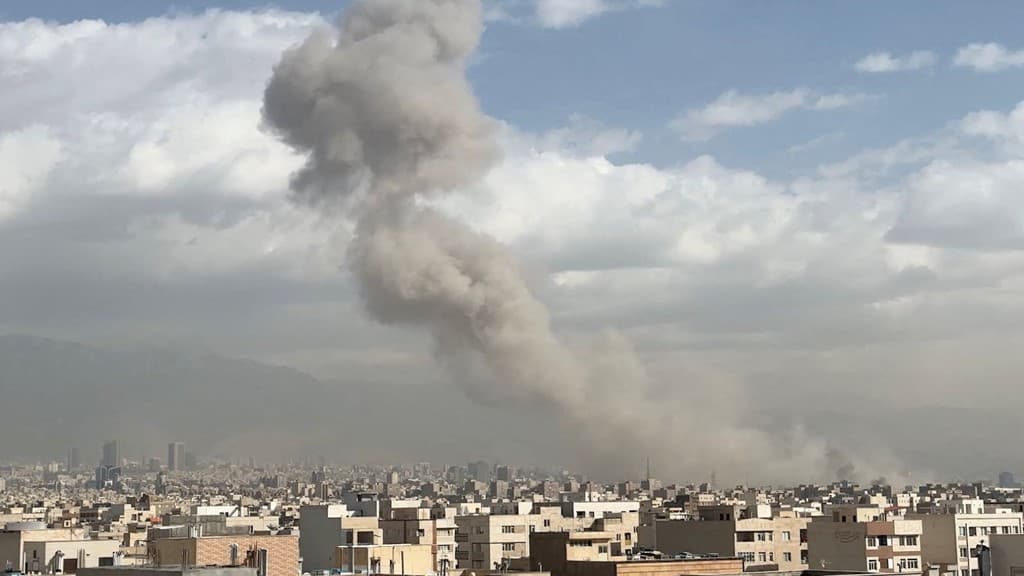
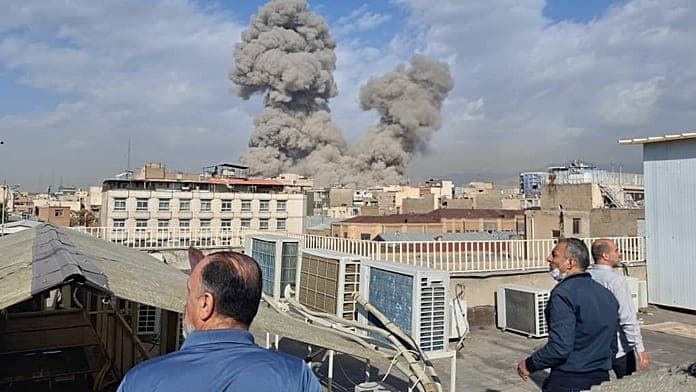
As the world reels from what Trump has called ‘major combat operations’ by the US military in Iran, we are faced with more questions than answers.
What kind of nuclear weapons do enemies Iran and Israel possess — and how many? Could the conflict trigger a wider regional conflict – or even World War III?
As the sound of bombing raids rings out once again in the Middle East, understanding what is at stake is more important than ever.
This is everything we know about Iran and Israel’s nuclear arsenals.
Does Iran have nuclear weapons?
Both US intelligence and the UN’s nuclear watchdog, the International Atomic Energy Agency (IAEA), have said that Iran closed down its nuclear weapons development programme in 2003.
But according to the IAEA, Tehran has in recent years continued enriching uranium, including to near weapons-grade.
All three of the plants where that was happening were hit in the last US strikes on Iran last June.
However, while Trump gloated that the strikes had obliterated Tehran’s nuclear facilities, IEA director general Rafael Grossi warned Iran could resume enrichment on a more limited scale within months.
Iran has not allowed the UN to inspect either of the damaged facilities at Fordow, Natanz and Esfahan since last summer’s ’12-day war’.
Just this week an IAEA report stressed it ‘cannot verify whether Iran has suspended all enrichment-related activities’, or the ‘size of Iran’s uranium stockpile at the affected nuclear facilities’.
The report stressed that the ‘loss of continuity of knowledge … needs to be addressed with the utmost urgency’.

Map showing where Israel has targeted Iran (Picture: Anadolu via Getty Images)
Iran now enriches uranium to near weapons-grade levels of 60%, the only country in the world without a nuclear weapons programme to do so.
Under a 2015 nuclear deal, Iran was allowed to enrich uranium up to 3.67% purity and to maintain a uranium stockpile of 300kg.
Since the start of his second term in the Oval Office, Trump has been working to reach an agreement on curbing Iran’s programme.
There had been several rounds of talks between the US and Iran until the Israeli attacks, and Trump had imposed new sanctions on Iran as part of his ‘maximum pressure’ campaign.
How far is Iran from a nuclear bomb?
A nuclear bomb isn’t something you can build overnight. It requires something called uranium enrichment.
Uranium contains a radioactive isotope called U-235, that can be used as a power source. The more refined it is – in other words, enriched – the more powerful. Power is increased by spinning U-235 in a container known as a centrifuge.
Nuclear power plants only need relatively unenriched uranium at 0.7% to 5%, while weapons-grade nuclear weapons require 90%.
The IAEA says Iran has about 400kg worth of uranium enriched to 60%. At 90% enrichment, this is enough for 10 warheads.
Iran Watch warns that the country could enrich enough uranium for one weapon in four months, and five weapons in one year and eight months.
However, it’s worth noting that Iran would also need to build a warhead and a missile capable of delivering it.
What missiles does Iran have?
Iran has the biggest stockpile of ballistic missiles in the Middle East, according to the US Office of the Director of National Intelligence.
Their range of 1,240 miles is enough for self-defence, Iranian officials have said, because they can reach Israel.
Many of Iran’s missile sites are in and around Tehran.

An Islamic Revolutionary Guard Corps (IRGC) missile launches during a military drill off Iran’s southern coast (Picture: Sepahnews/ZUMA Press Wire/Shutterstock)
There are at least five known underground ‘missile cities’ in various provinces, including Kermanshah and Semnan, as well as near the Gulf region.
Tehran’s missile arsenal is thought to include the Sejil, Ghadr and Khorramshahr, all with a range of 1,240 miles, as well as the Emad (1,050 miles), Shahab-3 and Hoveyzeh (830 miles).
Does Israel have nuclear weapons?
Israel’s military superiority in the Middle East comes not just through its conventional arsenal or the backing of the US, but from its nuclear arsenal.
Israel is widely believed to have one of the most advanced nuclear programmes in the world, but it has never confirmed or denied its existence.
@metrouk
Britain will buy a dozen F-35A warplanes, all capable of carrying nuclear weaponsm from the US, following criticism from Donald Trump that Nato members are not spending enough on defence. Sir Keir Starmer will tell a summit of Nato allies in The Hague that the new squadron will join an alliance mission that can be armed with US nuclear weapons. The prime minister is expected to say: ‘The UK’s commitment to Nato is unquestionable, as is the alliance’s contribution to keeping the UK safe and secure. ‘But we must all step up to protect the Euro-Atlantic area for generations to come.’ #uknews #war #fighterplanes #nato
♬ War Drums – Audiosphere
Because it has never signed to the non-proliferation treaty, Israel is not subject to independent IAEA inspections of its nuclear facilities.
Since the 1960s, successive governments have followed a policy of nuclear ambiguity. In the early days, Israel went to great lengths to hide its nuclear ambitions from the international community, even its closest allies.
Even US inspectors were misled during early visits to the Nuclear Research Center near Dimona, in the Negev desert, which was initially described as a textile factory.
Today, estimates of its stockpile range between 90 and 400 warheads, all of which could be delivered by air, as cruise missiles fired from submarines and through the Jericho line of ballistic missiles.
A few days before Israel’s attack on Iran, in which dozens of people – most of them civilians – were killed, Iran had threatened to release a hoard of Israeli nuclear secrets it claims to have obtained.
Iran’s intelligence minister, Esmail Khatib, claimed the regime had obtained ‘a vast collection of strategic and sensitive documents, including plans and data on the nuclear facilities’.
Why has the US attacked Iran?
In his statement last night, President Trump said the objective of his ‘major combat operations’ was to ‘defend the American people by eliminating imminent threats from the Iranian regime’.
He said: ‘Its menacing activities directly endanger the United States, our troops our basis overseas and our allies throughout the world.
To view this video please enable JavaScript, and consider upgrading to a web
browser that
supports HTML5
video
‘For 47 years, the Iranian regime has chanted “Death to America” and waged an unending campaign of bloodshed and mass murder, targeting the United States, our troops and innocent people in many, many countries.’
Trump added: ‘Iran is the world’s number one state sponsor of terror, and just recently killed tens of thousands of its own citizens on the street as they protested.
‘It has always been the policy of the United States, in particular, my administration, that this terrorist regime can never have a nuclear weapon.
‘I’ll say it again. They can never have a nuclear weapon.’
Could the Israel-Iran conflict lead to World War III?
Even after the involvement of the US, it is unlikely that it will result in a global conflict.
Speaking after the last strikes on Iran, Jason Pack, fellow at Royal United Services Institute (RUSI) and host of the Disorder Podcast, told WTX News that the regime has been ‘really weakened’.
He said: ‘The Iranians don’t have the capability to bring us to World War III.
‘It is much more likely to see the Iranian people rise up against the regime than we are to see the Iranians like land some decisive blow against Israel.’
Comment now
Comments
Add WTX News as a Preferred Source on Google






Great article! This really puts things into perspective. I appreciate the thorough research and balanced viewpoint.
Interesting read, though I think there are some points that could have been explored further. Would love to see a follow-up on this topic.
Thanks for sharing this! I had no idea about some of these details. Definitely bookmarking this for future reference.
Well written and informative. The examples provided really help illustrate the main points effectively.
This is exactly what I was looking for! Clear, concise, and very helpful. Keep up the excellent work!